Sunday, October 29, 2006

The double


I took me about six months to read The Double by José Saramago. Suffice it to say, it is not an easy read, at least through the first half. By the end it becomes something of a page turner.

Saramago’s style is like no other, or at least no other that I have read. A sentence may go on for a page; paragraphs regularly go on for several. One critic reports a 15 page paragraph. I have never counted, but I’m not at all surprised. Another Saramago convention is the lack of quotation marks or paragraph breaks to denote who is speaking. Thus we get examples like this:

To hear you Lord is to Obey, but I have one more question. Stop asking Me questions. Please, Lord, I must. Very well then, speak. Can I save my sheep. So that's what's bothering you. Yes, that's all, may I. No. Why not. Because you must offer it in sacrifice to Me to seal our covenant. You mean this sheep. Yes. Let me choose another from the flock, I'll be right back. You heard Me, I want this one. But Lord, can't you see, its ear has been clipped. You are mistaken, take a good look, the ear is perfect. It isn't possible. I am the Lord, and with the Lord all things are possible. But this is my sheep. Again you are mistaken, the lamb was Mine and you took it from Me, now you will recompense Me with the sheep. Your will be done, for You rule the universe, and I am Your servant. Then offer this sheep in sacrifice, or there will be no covenant. Take pity on me, Lord, I stand here naked and have neither cleaver nor knife, said Jesus, hoping he might still be able to save the sheep's life, but God said, I would not be God if I were unable to solve this problem, here. No sooner had he finished speaking than a brand-new cleaver lay at Jesus' feet. Now quickly, said God, for I have work to do and cannot stay here chatting all day long. Grasping the cleaver by the handle, Jesus went to the sheep. It raised its head and hardly recognized him, never having seen him naked before, and as everyone knows, these animals do not have a strong sense of smell. Do you weep, God asked. The cleaver went up, took aim, and came down as swiftly as an executioner's ax or the guillotine, which has not yet been invented. The sheep did not even whimper. All one could hear was, Ah, as God gave a deep sigh of satisfaction. Jesus asked Him, May I go now. You may, and don't forget, from now on you are tied to Me in flesh and blood. How should I take my leave of You. It doesn't matter, for Me there is no front or back, but it's customary to back away from me, bowing as you go. Tell me, Lord. What a tiresome fellow you are, what's bothering you now. The shepherd who owns the flock, What shepherd, My master, What about him, Is he an angel or a demon, He's someone I know. But tell me, is he an angel or a demon. I've already told you, for God there is no front or back, good-bye for now. The column of smoke was gone, and the sheep too, all that remained were drops of blood, and they were trying to hide in the soil.

When Jesus returned, Pastor stared at him and asked, Where's the sheep, and he explained, I met God. I didn't ask you if you met God, I asked you if you found the sheep. I offered it in sacrifice. Whatever for. Because God was there and I had no choice. With the tip of his crook, Pastor drew a line on the ground, a furrow deep as a pit, insurmountable as a wall of fire, then told him, You've learned nothing, begone with you.

That’s from The Gospel According to Jesus Christ, not The Double. I chose it because it is interesting and can stand on its own, as well as because it is representative of the Saramago style. The great majority of his long paragraphs, however, are not interesting in themselves. They add up though. Add up to a story.

I’ve read many of Saramago’s novels and have no problem with that style. In fact, I think it works quite well when it is employed to tell an interesting story, which is usually the case. The only novel I didn’t like was The Cave. Blindness is generally considered to be his masterpiece. I recommend starting with that if you’ve never read him. Or The Gospel According to Jesus Christ, which is my personal favorite. All of his books are allegorical.

The Gospel... is different from other Saramago novels in that the main characters are well known literary figures. The main characters in all of the other novels (I have read) are obscure people -- clerks, high school teachers, fact checkers and the like. The Double actually breaks new ground. “Common Sense” is actually a character in the novel.

The Double is like Blindness in that it is built on a “what if?” In Blindness, Saramago poses the question “what if everyone in the world went blind?” In The Double, the question is “what if one found that an exact physical duplicate of himself existed?”

The question of the double is not new. Extensive literature on the double, or Doppelgänger, exists, both in folk tales and psychiatric texts.
The syndrome of subjective doubles is a rare delusional misidentification syndrome in which a person suffers from the delusion that he or she has a double or doppelgänger with the same appearance, but usually with different character traits and leading a life of his own. Sometimes the patient has the idea that there are more than one double. The syndrome is usually the result of a neurological disorder, mental disorder or some form of brain damage, particularly to the right cerebral hemisphere.

Nevertheless, Saramago takes the idea and slowly meanders with it to unexpected destinations. How would we react if we learned that an exact double of us existed?

I won’t tell you how Saramago worked it out, but I actually had a similar personal experience that sheds some light on the phenomena. One night, one Christmas Eve actually, there was a murder at the corner store. I had been there earlier that night to buy a lottery ticket. I remember that the guy behind the counter, Julio, asked if I would share the prize with him if I won. No, and that’s for the record. I didn’t want him suing me for breach of promise if I won. There was a homeless man there as well. His hair was long and matted, his beard rough with white hairs poking out at odd intervals. He was wearing a green sweatshirt with a pullover hood hanging down the top of his neck. His sneakers had holes along the sides and I could see wet brown leaves sticking to his ankle, which was purple and swollen. He wore tattered brown corduroy pants that had a busted zipper. His shirttail protruded out of it like a pointy little dick.

I only remember the details so well because Julio was murdered shortly after I left and I had to describe the bum to the police. In addition to the poverty of his attire, he was a raving lunatic. He was telling Julio that Russian tanks were massing on the Polish border and that war was imminent. What do you think of that, Julio asked me after the bum had left. I laughed. I wouldn’t worry about it. The cold war’s been over for years. Yes, I know, but you never can tell. The world’s a crazy place. That guy’s a lunatic, did you see the shirt tail hanging out of his zipper? Yes, that’s always a sign, but still, you can’t trust the Russians, I shall listen to the news just to be sure. Never hurts.

Unfortunately, he never made it to his car. A masked gunman robbed the store shortly after I left and Julio was shot in the face. He died on the way to the hospital. It was big news, being Christmas and all. Julio had a wife and two children. They were devastated.

Anyway, I immediately went to the police and informed them that I had been at the corner store that night and might have some information that would break the case. I suspected that the looney with the broken fly was involved. I was wrong, though. The police had the surveillance tapes and showed me that the bum had not committed the crime. It’s eerie seeing yourself on a crime scene videotape and it was worse seeing Julio in the minutes before his death, which was now pre-ordained.

As of this writing, the murderer is still at large and I still go to the corner market to buy lottery tickets. A man named Kittim works there now. He has eyes like a lizard. Whenever I’m there I see everything from the slanted perspective of the security camera and I am transported back to that night. I am across the counter from Julio. I see the portents wafting about his head. At the time I didn’t divine their meaning but now they are clearly the vapors of death. It’s funny how these things are so obvious in hindsight. But I was right about the Russians. They had invaded western Europe and the country was in a state of emergency, the air filled with conflicting radio waves.

But I still think about the night of the murder, of Julio and the yuppie guy who came in the store after me. I had seen him again at the police station after the crime. We were in the bathroom together after the interrogation, pissing in adjacent stalls. We looked at each other across the divider and it was like I was transported back to that Christmas evening. Julio was processing my lottery numbers. The yuppie guy was looking at me like I was dirt. Who the hell are you? Then I noticed that his zipper was busted and his shirt tail was hanging out. He’s not so high and mighty, I thought. Then I realized that he looked something like me. Not a double, exactly, the portents were different, but close.

So I was interested in seeing how Saramago would handle the story and I thought he handled it very well.


Thursday, October 26, 2006

In retrospect


I've been working more or less simultaneously on this series of photos and the writing here that I've illustrated with some of them. Sometimes I chose the writing to go with the photograph, other times the picture dictated the prose.

Although I didn't start out with any theme in mind, certain photographs began to fit well together, at least in my mind. Here they are, along with a few you haven't seen, in a more comprehensive presentation.

It's unfortunate you can't see them as I do, in a seamless slideshow on a nice widescreen monitor. The web still has quite a ways to go.

Anyway, this page is now turned.

Tuesday, October 24, 2006

A more affluent power boater


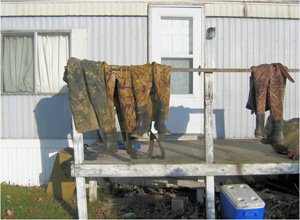
Consider this photograph. Larger image here.

I have nothing to say. It is what it is. You can make of it what you will. The meaning is entirely up to you.

You might think that it meant something to me. Perhaps it did, but maybe not. Would it help if I told you that the subject of the picture is the curtain on the left? That I was fascinated by its gray and white appearance in the context of the grays and whites of the trailer face and the porch? Did I even notice that? Or could it have been the juxtaposition of the hunting garb with poor mobile home, the image of the cross on the door adding a level of irony? Or was it just nostalgia. This was actually taken near my hometown and was a common scene in my youth.

Living in the cities or the suburbs as you do, you may not recognize the aspect of danger, but you probably feel it subconsciously. I could have been shot for taking this picture, you know, there was a shotgun involved. If risk is present, does that add something to a photo’s quality?

But before I explain, I’ll tell you what it’s not about. It’s not about politics. I do not like to write about politics and I am not a political photographer. I work for a respectable company that is a positive force for good in our economy. Photography is just a hobby and these musings I share are of no consequence. I have no interest in the political ramifications of life outside the cities. And you are probably better off not knowing what it’s like out there.

The photograph means nothing at all. It simply is. This narrative, on the other hand, is directed by consciousness. There is no telling which conscious or subconscious influences direct a person to take a particular photograph, or even if there is a conscious idea, the picture remains but an imprint of light reflected, completely free of intent. And if it seems to tell you something, that too is just a reflection, not of light but of you. These words, on the other hand, are echoes from my conscious mind that will bounce around in yours. For how long? We'll see, but they begin and end with meaning. They are nothing but meaning. It could not be otherwise.

I know that all sounds a bit ephemeral, but the story of how I came to take that photograph will clarify what I’m trying to communicate in a way that the photograph itself cannot.

My job takes me to all of the cities on both coasts and a couple of the few in between. During a project in Chicago I took a sdie trip to my old hometown, which is far from the nearest city or suburb. Of course I had moved my parents out of there as soon as I could afford it and hadn’t returned for more than twenty years, so I didn’t know anyone or have anywhere to stay. It was getting bad back then, but how much worse could it be? I asked myself. The news told me the situation was stable.

And it appeared to be okay when I arrived. The streets were quiet. I rented a room in a dingy hotel, drove around the town a couple of times feeling uneasy, but with no real sense of foreboding. I saw my old house and those of my long ago friends. I drove by the schools and the courthouse. I saw poor people sitting out in front of their trailers and shacks. I sat by the river and watched the boats go by and remembered my days as a power boater. That was pretty much it. When no one was watching, I took a few photos.

But things got very unpleasant shortly. I don't want to disturb you with too many details, but this encounter led directly to the photograph I’m talking about and serves to illustrate a lot of what I'm trying to explain.

I had gone out to the liquor store nurturing a faint hope of finding a decent bottle of wine. The shelves were mostly stocked with fortified wines and malt liquors as well as the more potent spirits. The line to the register was long and moved very slowly. It seemed like every other individual lacked the money to pay for the items presented to the cashier and would slow things down while he tried to borrow the difference from one or more acquaintances farther back in the line. Or maybe I just remember it, exaggerated, that way?

Nevertheless, the man directly ahead of me in the line most definitely came up short and looked around for someone to help him out. He hadn't given me a second glance until he started counting his change and then when he scanned the line in back of him, he recognized me as a long lost friend from high school.

I think that’s one of the reasons, beyond the obvious, why so many of us never visit the old hometowns. It’s bad enough when you don’t recognize someone who recognizes you, but it’s so much worse when the person in question is scary. This man was scary. He was unnaturally thin and his posture was stooped in an unhealthy manner. He had long thinning hair loosely framed around a bone sharp face and his eyes twitched sporadically. There was something unusual about his mouth too, but I didn’t stare. In fact, I looked away a little too quickly.

Chuck, he said, it's me, Dave, you remember your old buddy Dave, dontcha? And unfortunately I did. I’m a little short, he said, could you help me out?

Sure Dave. I paid for his liquor. Why shouldn’t I? It was nothing to me. I wondered how they made it that cheaply. Nice to see you again. Then I paid for my own. The bottle was dusty and hardly what I’d normally call drinkable, but it would have to do.

I dawdled in the liquor store, but he was waiting for me in the parking lot. We had a brief, stilted conversation about old times, the details of which I did not want to remember. He invited me to come out to his house some time for a beer. I said I'd love to, gave him a few bills to help him out with the rent, and we parted. Of course I had no intention of visiting him, but I did. Thus the photograph.

I had an uncomfortable night in the hotel. The bed was lumpy and the wine bad. I had planned to leave first thing in the morning, but after a shower and some breakfast I decided to take a drive through the country before heading back to the city. I spent a good deal of time on the river in my childhood. I wanted to see it one last time.

So I drove out to the old ramp where my father used to launch our boat. Apparently no maintenance had been done on the road in all those years and it was little more than a dirt path when I finally reached the river.

I got out of the rental car and looked around. The river was brown, seemingly thick, with rainbow colored eddies swirling in and out of existence along its banks. Behind me was a vast field, empty of all but weeds and refuse. A light mist rose mournfully to a distant tree line. Up the river to my left were gleaming silver factories with bright fluorescent lights and thick white clouds billowing in the early morning sky. The steady rat-tat-tat of an approaching powerboat was an annoying counterpoint to the industrial noise. I remembered that dad’s powerboat was much quieter. I took a few photos. I’d seen enough. My shoes were covered with mud and it stank.

Going back the way I came, I saw a truck stopped with its hood up in the distance. As I approached, a man appeared from behind the hood and stood in the road waving his arms for me to stop. Thinking it could be a trick, I sped up and took an angle that would allow me to cut around to the left and get by him, but when I got close I realized that it was Dave from the liquor store. So like a fool I stopped. His truck had broken down again. I offered to give him a ride to town, but he asked if I would take him home instead. It was not very far and he could find the parts he needed there. He seemed quite agitated. I reluctantly agreed.

His house was not a house but an old trailer, as you can see in the photograph. There was also a rusted camper, the kind people used to pull behind their station wagons, with blue plastic canvas stretched out to make a porch. He asked me to sit outside and wait while he went in to take something to ease the pain in his gums. He said that he had had all of his teeth pulled recently and that it had been very unpleasant. There was an overwhelming chemical smell coming from the trailer and I saw industrial looking cans in the brief glance I got when he opened the door. While he was inside I took the picture.

When he came back out, he had a shotgun. I made my excuses and hurried away, leaving him with a small amount of money to by food for his kids, who he said were staying with his ex-wife. I don't know if he even had any kids, and hoped not for their sake. I was happy to pay any toll to get out of there and back to civilization.

So you see? This narrative may or may not add anything to the photograph and the photograph, being little more than reflected light, tells us absolutely nothing. But the narrative does tell us something about our lives. It does illustrates how important it is for us to continue working hard so that we do not lose our jobs and endanger our status. It shows how bad things can be for those who fail to make the necessary effort. That's all I wanted to say on that subject.

I hope you enjoy the photograph. That’s all I really want to say.

Wapo uncovers stategy to clone george w. bush

"They read so fast, with no punctuation and no expression, that we'd go back and ask comprehension questions and they weren't very successful answering them. They hadn't understood what they read," he said.
That, from an article in today's Washington Post that show's Bush's education policy has focused on reading speed rather than comprehension and understanding.

Kinda sounds like the Iraq war "strategy." Victory determined by the speed with which the army could get to Baghdad, never mind all those massive arms depots they left unguarded along the way.

And every other "strategy" for that matter. Because the Bush administration is such a colossal failure in so many areas, academics will never find a lack of atrocities to analyze. The assault on reading comprehension will no doubt be deep down in the mix.

Unfortunately, the inability to understand what one reads is a cornerstone of failure and being taught taught in such a way that allows one to "succeed" without understanding will produce a large number of people who don't read at all and won't be able to understand meaning much deeper than street signs if they do.

Not that that will stop them from growing up to be president or anything, but still...

Sunday, October 22, 2006

The great northeast

Althought I catch nothing but shit about my theory that the "Democrats" are little, if anything, more than a figment of people's imagination, I did get some positive comments on my fall foliage pic.

So here, by popular demand, are a few more from the same "roll."

Saturday, October 21, 2006

Helpful advice for imaginary friends


As you probably know, I don’t believe in the Democrats. I don’t believe in them in the same way that I don’t believe in Santa Claus. I simply don’t believe that they exist as an independent entity. They have the same relationship to the Republicans as the Washington Generals have to the Harlem Globetrotters. They are professional foils, that’s all, they will always bow to the people signing their paychecks.

Witness the current campaign for Congress. The “Democrats” have no policy differences whatsoever with the Republicans. The only thing the “Democrats” promise is to carry out the Republican policies more capably.

Nevertheless, on the off-chance that I am too cynical, I offer this strategic advice: Taint the Republican candidates with the word “Bush” in every pejorative way imaginable. John McCain, for example, is “Bush-whipped.” Not only are the Republican candidates Bush-whipped, they support Bush league strategies. In short, they are a bunch of stupid pussies. That’s a message the Nascar crowd can understand, even after a case of Bud Lite.

I’ll go out on a limb and predict that the Republicans will hold both the House and Senate, even if the “Democrats” technically win. And yes, they can go out and celebrate by fucking a cow, and probably will, but that doesn’t do the rest of us any good.

On a happier note, enjoy the fall foliage. Larger image here.

Tuesday, October 17, 2006

Please pardon this interruption of our regular scheduled programming

I am going to spare you my usual bullshit and give you a window into a world not many of us get to see. One of my projects is the study of elite prep schools here in New York City. I have done a lot of reading, spoken with experts, visited many schools, met with teachers, administrators, students, and parents, and sat in on classes. These are the schools that feed the Ivy Leagues, the schools attended by the children of the most wealthy and talented. Tonight I got to go to a group 2nd grade teacher meeting.

One of my areas of interest to compare and contrast the teaching methods and results of the city’s gifted and talented programs with the elite prep schools. New York City has at least three of four high schools that are up there with the best prep schools in terms of test results and admissions to the best colleges, yet the way they achieve those results is radically different. Although the public school kids learn to read and do advanced math and take tests, intellectually the prep school kids are many years ahead of them by 7th grade. I’ve been looking into the lower grades to see how this occurs. The answer, of course, is primarily money and the teaching skills that money can buy.

Don’t get me wrong. I’m not dissing the top public school teachers. They are very good at what they do. It’s just that in addition to hiring more than twice as many teachers that do more or less what the public school teachers do, the elite schools also hire other teachers that do a whole lot more.

Tonight, for example, we started out with the primary teachers in the main classroom. They explained what the children were doing and how those things were necessary building blocks for more advanced activities. Then we went to the music class where the music teacher explained what the children were doing and how those things were necessary building blocks for advanced activities, and how the music knowledge and exercises were integrated with the rest of the curriculum. Then we went to the Dance class where the instructor explained what the children were doing, how those things were necessary building blocks for advanced activities, and how the dance practice was integrated with the rest of the curriculum. Then we went to the art class where the instructor explained what the children were doing, how those things were necessary building blocks for advanced activities, and how art was integrated with the rest of the curriculum. Then we went to the Library where the librarians explained the same thing, then the Gym class where the Gym teachers went from individual details to the big, integrated picture.

And finally we met the Poetry teacher who very eloquently explained his subject the same way. The children were learning all kinds of different forms short of iambic pentameter, but clearly paving the road in that direction. I don’t remember all the names of the names of the forms. I spent maybe 2 hours on poetry through 7th grade and it never go much beyond, "roses are red, and ready for plucking. Betty's sixteen, and ready for high school," or the like.

I'm not making the arguemnt that the teaching of the various arts are good because they may help with reading, writing, and math. Apparently there are no definitive studies in that regard. I agree with the arguent in the previous link, that they are good in and of themselves. As they say, no one argues that history is a worthy subject only to the extent that it helps an increase in students' proficiency in other subjects.

Anyway, this poetry teacher had a bit more to say and it tells you a lot about the difference between these very elite schools and every place else.

"Some of your children will go on to study poetry all the way through high school," he said, "but most will concentrate on other things. Some will write plays, some will write novels, others will become physicists, mathematicians, doctors, actors, or film directors. But they will all come out of the lower school understanding poetry. They will get it. And when they are in high school or college, they will be able to read a poem, discuss it intelligently and write about it if called to do so."

They really will go on to do those things and I will tell you something. I went into this project with a bad attitude towards these schools. The Ivy League and other top universities have produced the majority of the scum that are fucking up our country so badly and I expected to find the seeds of that in the lower grades of the elite prep schools. But that has not been the case.

Of course I have not been to all of them. I have not been to Exeter, which produced George W. Bush, but nothing I have seen in other top schools even begins to explain how a person could come out of them as such a twisted, pathetic, genuinely stupid human being. The only lesson I can draw in that regard is that the blame falls falls on the parents, not the schools.

I guess there will always be worthless assholes, no matter where they go to school, but that's a different issue.

The larger problem is not that the elite schools can buy such great education, it is that the other 99.5 percent of the schools cannot. Please excuse me for dragging out the old warhorse of all education related complaints, but we are literally spending trillions of dollars in Iraq and Afghanistan to make the world a more stupid, violent, and dangerous place. And how many trillions more for the defense budget? For a “defense” that endangers us all?

Why can’t we spend that money to give all schools, or as many as possible, the resources of the elite schools? That would do more for national security, and religious values for that matter, than 99 percent of all the missile systems and nuclear bombs in the world.

Okay, okay, enough with the rhetorical questions. The reasons for the distribution of resources in our society is not a mystery and I gotta go to work in the morning. Good night.

Wednesday, October 11, 2006

Another post about the brain


Larger image here.

I am not putting this out there as a finished work. It is a work in progress. Not this particular photo. This one is done. But towards some photos I am trying to take, photos that will be very much like this one.

Actually, it goes towards two different projects. The one, to get the light-dabbed shadows look I have in my minds eye, which is what this post is about; the other to photograph Greenwood Cemetery.

There was a painting in the old Bayou Grill in New Harmony, Indiana that got me started on this. It depicts a young priest walking through a grove of sycamore trees, the ground around him dabbed with ovals of light through the branches. What sets it apart is the nature of the light. It is not yellow, but white. Great splotches of white. Many times over the years I've tried to get that effect in a photograph but until a recent eureka moment had no idea how to go about it.

One of the most interesting things about the practice of photography is the need to understand how the brain works. So many photographic subjects appear to come out looking nothing at all like they did when we photographed them. The whitest snow, for example, is deeply saturated with blue in the photograph; our children's eyes, so clear when we snapped the photo, are invisible in deep shadow when we get the print.

The key thing to understand in those situations is that the camera is recording the information accurately. The snow really is blue and the kid's eyes really are lost in shadow.

Our brains are ultra-sophisticated versions of Photoshop. We expect to see white snow, so our brain makes it white. We expect to see a person's eyes in his face, so our brain cuts back the shadow.

Often, the trick to getting a good photo is to outsmart the brain, to see the image as the camera will see it. Once we can see light, shadow, and color as the camera sees them, then we can take the photo in such a way as to manipulate it the way our brain manipulates the original image.

Here, for example, is the original of the picture above.

Many people are appalled by the use of Photoshop these days and do not want to buy photographs that appear to have been manipulated. I agree that a lot of photographers make poor aesthetic choices in their use of Photoshop, but I only care about the finished photograph. If it is well-composed, colored, and imparts a feeling, then I don't really care if or how it was manipulated in the darkroom. In my own work I typically manipulate the image to either look like it did when I took it, or how it does when I remember it. The picture above is very close to working for me that way.

Thursday, October 05, 2006

Strange Brew


Critics do not generally rank Max Von Sydow’s work in the film Strange Brew among his best, but perhaps now that 20 or so years have passed, it’s time for a critical reassessment.

Strange Brew is the tale of Brewmeister Smith , a great pyschiatriest as well as a brewmeister, whose megalomaniacal desire to rule the world leads him on a downward spiral of violence and murder. Max Von Sydow gives a complex and poignant performance of the brewmeister, rivaling his work with Ingmar Bergman in such films as Winter Light but falling short of his more recent effort in Hamsun.

Although it is an outwardly unserious film, if you look for deeper meaning you will be richly rewarded. Beneath the comedy, Strange Brew is a tragic fable of people leading desperate lives. Like Bergman’s films, it takes place in the great white north and is infused with the chill of the colder clime. Gloomy lighting and long meditative takes convey the burden of the Brewmeister’s worldview and his efforts to rule the world validate him as a misguided hero/martyr. The bathos is experienced on a visceral level when he gazes at the lights on the map of the world he hopes to rule, his personal inadequacy there for all to see. Von Sydow brings depth to this characterization as only he can.

Unfortunately, the movie does not focus entirely on the character of BrewMeister Smith. His tale is told largely through the actions of two of his employees, hapless brothers, a pair of sociopaths whose disrespect for societal norms is demonstrated by their alcoholism and inability to focus on their work. In one part, the brothers create a movie within the movie, but it is unfocused and the set designs and dialogue are unintentionally laughable. These buffoons, with the unlikely help of their dog, ultimately wreck the Brewmeister’s plans. One could have only wished for a more capable foil.

Were it not for Max Von Sydow’s presence I would not recommend Strange Brew, but Max is without question one of the greatest actors of our generation and none of his films should be missed. I’ve been a big fan ever since I saw Steppenwolf in downtown Philadelphia when I was fourteen years old.

A kid I knew, Allen, had moved to the Philadelphia suburbs the previous year and was having a hard time adjusting to his new life. His parents had invited a number of his friends to come visit, but none would let their child go off alone to the big city at the tender age of fourteen. Ultimately, I was invited because I was the only one who would be allowed to go.

We had never been that close. Actually, we had never even been friends, so I ditched him pretty much immediately after I got there. I met some other kids in his class and hung around with them most of the time. They were into hockey and when Allen came around, they’d say, take off, hoser. I didn’t play hockey, but we had a good time playing soccer, smoking a little weed, doing acts of petty vandalism, and torturing Allen.

But during the weekdays everyone was at school, I had nothing to do so I took the train into downtown Philadelphia and roamed the big city streets. In retrospect, it was totally irresponsible of his parents to let me do that, but by that point they were so disgusted with my behavior toward Allen that they didn’t care what happened to me.

I had never been to a big city before and I felt like I was in the land of Oz. I have vague memories of skyscrapers and the hectic city life of people in business suits walking briskly to and fro, but it was the seamy side of downtown that caught my attention and resonated in my life for many years. I walked streets littered with trash and broken glass past sex shops, boarded up buildings and graffiti covered walls. There were very tough looking black guys selling drugs, bums curled around bottles of Mad Dog 20/20, and hookers getting an early start on the night.

Being a Christian boy from the Midwest, I was fascinated by the sex shops and adult theaters. Iwalked back and forth in front of them for large parts of several days, but could never get up the nerve to go into one. Eventually, I settled for seeing R rated movies in regular movie theaters. First I saw Young Frankenstein, which had its titillating moments, but was pretty far from what I was hoping to see. Then I saw Steppenwolf and got my first introduction to Max Von Sydow. It had quite a bit of nudity and sex, but it was the theme of the movie that captivated me. I felt a strong kinship to Harry Haller as he stood in front of the mirror with a razor at his throat. I too was leading a life of quiet desperation, I too felt like an alien shackled by society and its crass commercialization. It was powerful stuff for a fourteen year old.

When the movie was over, I had forgotten about sex entirely. I took the train back out to Allen’s house and thought deeply about the meaning of life.

The next day, however, I was back downtown, walking the devastated city streets looking at the whores and trying to get up the nerve to go in one of the sex shops or adult theaters. Like a lonely wolf of the steppes, I sauntered down a side street I had never seen before and came across a sign that said “Magic Theatre.” It had images of women in bunny bikinis. I felt like heaven had opened up and Jesus reached out and whacked me on the head. This was a sign that God wanted me to see some porn. And maybe some sensual adventures would follow.

I know you. You’ve already figured it out. The sign was not what I thought. I paid my money down and sat in the nearly empty room waiting for my revelation, but it really was a magic show. The only revelation I got was that a guy could hammer a long nail up his nose without killing himself.

But things did get very weird. Allen’s father killed himself that night in the bathroom with a razor, though it was his wrists he cut, not his throat. I was put on the next plane home and didn’t see Allen again for 15 years. Strangely enough, he became a professional hockey player, though he never got beyond the minor leagues. Just by chance, I watched him skate for a Canadian team in Spokane one time, but I made no effort to meet him. I figured he’d probably just tell me to take off. He didn’t do anything to distinguish himself in the game and had a nervous breakdown soon after. I later heard from another friend that he was incarcerated in a mental health clinic near Toronto.

But anyway, when I saw that Max Von Sydow was in Strange Brew, I was transported back to that long ago day in Philadelphia and I confess that when I put the tape in the machine, I thought I might find some deeper meaning. Did I, well no, of course not. Brewmeister Smith is a mighty cinematic figure, but he is no Harry Haller. When the movie was over, the only thing I contemplated was a beer. Still, even though it’s not Steppenwolf, I heartily recommend Strange Brew. There are worse things to contemplate than beer, eh?

Wednesday, October 04, 2006

Tornado Days


This is a house in Henderson, Kentucky taken last fall after the big tornado that tore through the area killing more than 20 people across the river in Indiana. It's just a typical American house. As a photographer, I question the value of pictures like this of things that are just mind-numbingly typical. On one hand, I think of posterity. Pictures of common things that no one bothers to photograph don't look so common with the passage of time. On the other hand, anyone can take this picture. It doesn't require any particular skill, either technically or compositionally. But on the third hand, I still see something that appeals to my aesthetic in this. Of course I've manipulated it somewhat in the darkroom to make its appearance consistent with my mind's eye.

With all the fantastic improvements in photographic technology, the ability to translate the mind's eye will more and more often be what separates the pro's from everyone else. I see tourists everyday with equipment equal to my own and it's just going to keep getting better and less expensive. Professional photographers will have to continually go to further extremes to seperate themselves. I saw a show recently at the Brooklyn Museum featuring the work of Edward Burtinsky. There was one fantastic shot of a field of oil wells in California. I wondered how he was able to get such a shot. The answer turned out to be that he rented a crane. That plus he had an 8 x 10 camera. Another example is an acquaintance who regularly rents helicopters to get the shots he wants. That's all well and good, but for us lower class folk, we have to struggle a bit harder to find compelling images.

Anyway, larger image here.

Sunday, October 01, 2006

The rosy scenario

I was looking for a quote from Kurt Vonnegut yesterday and came across scattered references in which he talked about how the U.S. has become a one party state and how he believes there is absolutely nothing we can do about it. Those, essentially, are the conclusions I have reached.

Regarding the idea that the U.S. is a one party state, I didn’t get it from Vonnegut. I’m pretty sure that I first heard it from Noam Chomsky, but that doesn’t matter. I am not a follower of Chomsky or Vonnegut or anybody else for that matter. The question of whether an idea is valid or not has nothing whatsoever to do with who does or does not espouse it. That kind of thinking is known as the “appeal to authority” logical fallacy.

I did not have any kind of “Eureka” moment when I first read that the U.S. was a one party state. In fact, I thought the idea was ridiculous and I still find it easy to slip back into naive hope that democracy will prevail. But it won’t. Although it’s difficult to grasp that so much of what we’ve always believed is illusionary, the evidence for the one party state is overwhelming. Of course this is a mere blog entry, not a book with thousands of footnotes and an annotated bibliography, so I could not present all of that overwhelming evidence even if I did know it all. But for sake of argument, start by considering the ramifications of the facts that we had a coup d’etat in 2000 and that the House and Senate passed the Stalinization of America Act, or whatever they called it, a few days ago, which declared the president to be an all powerful dictator who can jail and torture anyone for any reason without any review by anybody. Then watch the twin pillars of your illusionary country dissolve before your eyes.

And there is nothing that you or I can do about it. Inexorable historical forces render the actions of individuals meaningless in the long term. I will even climb to the apex of apostasy and say that the coup of 2000 does not matter. If Al Gore would have been allowed to take office, things would eventually end up being more or less the same. The details would of course differ, but at some point in near future, we would find ourselves in precisely the same place. The anti-democratic historical forces have too much momentum.

I know this is not a popular analysis and I’m not at all saying that people shouldn’t fight it. I have the greatest respect for the people like Kos and Atrios who believe that there is a Democratic Party and that we can turn back the tide of history by electing them. In fact, my advice is to act as if we do live in a vibrant democracy and really do have the power to make positive changes. Maybe my thoroughly defeatist analysis is wrong? It’s certainly best to act that way, just in case. At least for now.

I say “at least for now” because, as non-Muslim American citizens, we can still say and do pretty much whatever we want without fear of losing our jobs. going to jail, being tortured, or killed by death squads. I do not believe that we will have these freedoms much longer. so if you are inclined to fight (non-violently) for them, now is the time.

But once it comes to the point where criticizing the government will destroy your life, my advice is to choose life. Odds are, you’ve only got one.

Monday, September 25, 2006

Dark Days


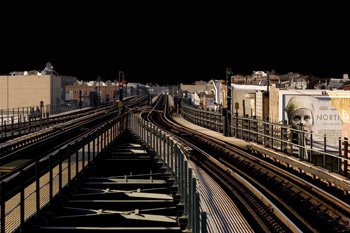
I've been too lazy to write, but hate for you to drop by and not get to see any new content. So here is a sample from my Dark Brooklyn series. I've been working on the project for several years now, but this is the first time I've shown any of it. I'm not at all confident that the idea is worth pursuing. Yet I pursue it.

I remember reading a review of a movie about a photographer from a small town in Spain who came to New York and went gaga over the Manhattan skyline. The joke was that he didn't realize how pathetically unorginal his ideas were. Of course that was Manhattan. I don'think anyone's ever taken pictures of Brooklyn before. I hope not.

Tuesday, September 19, 2006

Paul Auster is a very bad man


I’ve been reading Paul Auster lately and want to tell you about his work. But as I’ve mentioned before in these pages, I very much dislike the typical book review.

I have read The New York Trilogy, Leviathan, Book of Illusions, and am deep into Timbuktu. One of the things I hate most about typical reviews is the plot synopsis. If I were to tell you that Leviathan was about a giant sea creature that emerged from the darkest deep to terrorize New York City and how a wise-cracking police detective and a seemingly frumpy marine biologist came together (in more ways than one) to fight the menace, that kind of retelling would negate any possibility that you would get to experience the unfolding of the story in the way that the author intended. And isn't that what it's all about?

But as much as I dislike the plot synopsis, I think traditional book reviewer’s incessant quest to find the author’s real meaning is even worse. If I were to tell you that Timbuktu was about Paul Auster’s search for true love in an imaginary land surrounded by harsh and forbidding desert that represents the aridity of modern society, not only would I be guilty of committing the same wrong as straightforward plot synopsis, I would also be mistaken in my analysis, for who can accurately see into the conscious and subconscious mind of an artist?. More than just ruining any possibility of my readers experiencing the work as the author intended, I might also bias their reading of the work in a way that is diametrically opposed to the author’s intentions. What if Timbuktu is really about the escape from romantic entanglements and the search for sanctuary in an isolated, pristine environment far from the cloying togetherness of modern society? Or something altogether different?

Another problem with the plot synopsis and the search for the true meaning of the work is that people may not read the book at all because they don’t like stories of that type. If I were to tell you that Book of Illusions is about a magician who hides his inner pain with the aid of magic tricks, you might not read it simply because you don’t like books about magicians or because you don’t like books about people who hide their inner pain. That kind of thing happens all the time and the sad part is that it negates the possibility that a story can transcend its subject. A great storyteller can conceivably make any subject a great story. We miss so much, for example, if we don’t read One Hundred Years of Solitude because we don’t like stories about people in small towns.

And worst of all is when the reviewer focuses on the life of the artist. The artist’s life may be interesting at some point after one has read his or her work, but knowledge and speculation on that subject can only damage the possibility of discovering the work the way in which the author intended. It's best to approach literature humbly, in as close to total ignorance about the work or its author as possible.

Unfortunately, I started letting the challenge of reviewing Auster’s work without actually discussing either it or him get me down. I don’t think it’s giving anything away to say that his purpose is not to create transcendent joy in the reader. It is, after all, literature and literature normally deals with the full spectrum of human experience. Literature is not about exclusively good things happening to extraordinarily happy people leading happy and fantastic lives and then going to heaven where they live happily ever after. Perhaps it would be nice if humans were wired that way, but we're not. Sometime bad things happen and we are often richer for them, both in life and in literature. And in addition to reading Auster, I also started watching Solaris over and over again, the film by the Russian director Tarkovsky, which is thematically similar to Auster’s work.

I think that my immersion in Auster-land, along with other things going on in my life, put me in something of a funk. In general, I am not the type to whine about these things. Sometimes life gets us down a bit, but who are people such as you or I to complain about our petty existential ills when there is so much real suffering going on in the world? Nevertheless, I complained about my little bout of depression to my cousin who lives in California. He suggested that I get out of my tiny dark New York apartment and get some fresh air and sun. It’s not that I didn’t know that without being told, but sometimes it helps when a caring outsider affirms our inner knowledge. I decided to get some fresh air.

So I put Paul Auster in my backpack, along with the DVD and my laptop, and went out to find a better place to read and watch Solaris. My first idea, naturally, was to go to the park, but although the idea to get some sun sounded good in principle, in practice I sunburn easily and need to stay in the shade. Plus, so much light made watching Solaris difficult. And I found the joggers, dog walkers, and other assorted park goers annoying. I decided to go to Greenwood cemetery instead.

That turned out to be a very good idea. I found a shady spot by a mausoleum on the side of a hill, rested my back against the cool hard stone and continued my reading and Solaris watching. There is very little city noise among those hills and a slight breeze rustles the leaves enough to cover it completely. Every now and then there would be a car, usually Greenwood security, and occasionally someone would walk by on the road below, but for the most part I enjoyed a splendid isolation and began to cheer up.

Nearly a week passed this way and I got a lot of work done. But during idle time I observed my surroundings. I got to know the names on the graves and mausoleums within my line of sight and pondered the folly of these all too human rituals. I came to recognize the guards and could even anticipate their rounds. And I began to notice a few recurring visitors, one man in particular.

Every day, precisely at 11 am, he came into the cemetery, sat down under a Beech tree and stared at a particular marker for about 10 minutes. At first this daily ritual did not intrude on my consciousness, but as the days passed I became curious and eventually went down and looked at the stone after he left. The name was Michael Webster. He was born in Knarlesborough, England in 1803 and died in Brooklyn in 1856. What was so special about this grave? Obviously, it must have been a relative, but why would someone who died in 1856 matter to this man today? Why would he come to the cemetery every day, precisely at 11 am, to stare at this marker?

These questions began to gnaw at me. I don’t know why. I had never done anything like this before, but for whatever reason, I decided to follow him. Every day, after staring at the Webster tomb for 10 minutes, he took the same path deeper into the cemetery, eventually disappearing over a hill. One day, I positioned myself at the top of the hill and observed that he visited another gravesite every day, the site of a woman and child who had died nearly a year ago.

With this information, it was easy enough to solve a big part of the mystery. The woman and child who died the previous year were survived by one husband and father, a guy named Michael Webster. So this guy was Michael Webster, just like the name on the tomb. Every day he comes to the cemetery, visits a grave with his name on it, then mourns the loss of his wife and daughter. It all made perfect sense, except the stone with his name on it, and I should have left it right there, but the mystery remained. I was intrigued by his behavior and decided to follow him further.

After visiting the gravesites, he left the cemetery at the Prospect Park West exit, walked across the expressway, turned left and walked down to 5th Avenue. He walked slowly, looking in shops and reading menus until he got to Union Street where he turned right and walked up to the library. After spending several hours in the library, he continued up Eastern Parkway, cut through the museum parking lot and walked through the Botanic Garden. After that, he crossed Flatbush Avenue, entered Prospect Park, walked around the lake, and exited by Prospect Park Southwest. Finally, he walked over to Church Avenue and entered a walk-up on one of the numbered streets. Every day he made this same trip, usually looking in the same windows and reading the same menus. This went on for nearly a month.

Meanwhile, my wife had left me and the landlord was questioning me about the rent. I had lost a lot of weight and let my hair and beard grow longer so as not to be recognized in my daily surveillance. I was wondering when and where it would all end, and then it did. I was no longer waiting for him in the cemetery, but picking up his trail as soon as he left the apartment in the morning. On that final day, he wheeled out a little red shopping cart filled with books, paper and some sticks of firewood. Instead of going to the cemetery, he went straight to the park. First he meticulously cleaned all the ashes from one of the picnic grills, then started a fire and burned all of the books and papers. He carefully put the newly created ashes in a sack and walked over to the cemetery. He spread most of the ashes in the grass on the graves of his wife and child, then threw a few in the air by the grave of his presumptive ancestor. After that he walked to a car service on McDonald Avenue, got in a car, and disappeared forever. I have searched on the internet for information on his whereabouts with no success. I considered hiring a private detective, but no longer have any assets, so that idea is impracticable.

By this time, a careful reader will probably have figured out that there is one more thing I need to clear up, and then I am through. As I was following Webster home after he had spread the ashes on the graves of his wife and child, he did a quick about face and bumped right into me. “Excuse me,” he said and stared at me with a strange expression. “No problem,” I said, expecting to move on, but he just stood there, looking me in the eye with a malignant grin on his face. “No, really,” he said, “it was clumsy of me, bumping into you like that. Is there something I can do for you? Perhaps some question you would like answered?”

I was taken aback by his insolence and completely at a loss for words. “Have you ever seen Solaris?” I asked. It was the only question that popped into my head.

“Yes, I have seen it,” he said.

“What did you think?”

“I thought it sucked, but I heard the Russian version is much better.”

"yes, infinitely so," I said.

He continued standing there, looking at me. “Anything else?” he asked. “Paul Auster,” I said. “What?” “Have you ever read Paul Auster?”

“Yes,” he said. “As a matter of fact I have.”

“What did you think?”

“Auster is great,” he said. “Anybody who likes great literature should read him. Start with The New York Trilogy.”

So there you have it, straight from the mouth of a crazy man.

But if you ask me, Paul Auster is a very bad man.

My advice: stay far, far away from his books.

Sunday, September 17, 2006

Slow times


It's been slow motivation-wise lately and I haven't been doing much work. Yesterday, I had descended to the point where I was working on my screensaver and came across this old photo, which had never interested me before. Of course the original didn't look a lot like this, but I saw it anew, with darkroom eyes, and made it what it is.

A larger version can be seen here.

Wednesday, September 13, 2006

Who'da thunk it?

I was looking for reviews of Solaris (Tarkovsky version) when I came across the Top 100 Spiritual Films list. I was not particularly surprised that Solaris would be on a list of spiritual films, but I was surprised that it would be on a list of the best spiritual films at a Christian website. The movie is certainly open to a multitude of interpretations, but I find a Christian one difficult to formulate.

But the Arts & Faith site is full of surprises. A lot of it is just what you would expect – The Gospel According to Matthew, John, etc., Jesus of Nazareth, Peter and Paul, the Passion of the Christ. But surprisingly, there were many films that are good by any measure and don’t jump out at you as being Christian. Then there were a few that were jaw dropping surprises, Dogville, first among them.

I like Dogville very much and can argue that it is a spiritual movie, but not a positive one. Sure, the secular humanist philosopher comes off badly, but the good church going town folk turn out to be morally flawed, to put it mildly, and they neither seek nor find any redemption. If it is about spirituality, it is about the crushing of the spirit and its rebirth as a bitter and vengeful thing. And where is the Christian message? That one should say to hell with all that forgiveness shit, join the gangsters and slaughter anyone who ever wronged you? Yea, I could be cynical and say that is what today’s Christianity is all about, but that is not consistent with the depth and independence of the list. Take away the obvious Christian movies and the ones that remain would provide a good start for many right wing Christians' list of worst movies of all time.

Monday, September 11, 2006

Just a reminder


See the look on these people's faces. This is what terror really looks like.

Television never showed what it was really like to be near the World Trade Center on 9/11. Sure, the buildings were there, and they were burning, but somehow out in TV land, the horror was in the loss of the buildings, but under the buildings themselves, the horror was at the people up there dying, and some of them falling, the same people we saw in the street every day.

And that look of shock and horror on everyone's face. And the smell. And the steady shower of paper. Those things never made the news, but those things are what we remember.

Sunday, September 10, 2006

Report from the fetid streets of hell

Living in New York, you can have some really bad days. Airplanes fly into buildings, people fall from the skies. the electricity goes off for days, transit strikes add hours to already hellish commutes. There are blizzards, heat waves, rain and wind and hundreds of little hassles. You get on a subway car with no air conditioning or a homeless person who couldn’t smell worse if he were dead. The noise, the smells, the rats, the existential ugliness of the urban landscape and so many of the people who inhabit it. Yes, any time or any day, things can turn very unpleasant very quickly.

But the reverse is true as well. When life is good here it can be very, very good. Sometimes it can be very good in big ways, sometimes in small. Yesterday was one of those small-time good days that make me more comfortable being a member of the human species.

I am not the most social person, to put it mildly, so when my wife informed me that there was a neighborhood block party and it was my chance to meet the neighbors, my response was “why would I possibly want to meet the neighbors?”

Our street was blocked off and people had brought out a lot of lawn and beach chairs and set them down in the middle of the street. Three tables had been set up and were covered with food and board games. A nice lady had a grill hooked up and was making chocolate chip pancakes for the kids.

Several of the nearby businesses had kicked in some money which was used to hire a magician. Everyone brought some kind of pot luck and the Mexican restaurant on the corner provided free roasted corn, hot dogs, and a stream of taco and burrito sampler platters. The fire department sent a truck and let the kids explore it and the firemen opened up a hydrant. Throughout the day there were 20 to 30 kids running up and down the length of the block. We had a few beers. It started at 10 am and there were still a few people left when I went home for the last time a little after 11 pm.

I live in one of the more ethnically diverse neighborhoods in New York, which is saying quite a bit, and our block party was representative. There were white Americans, Germans, Japanese, Africans, African-Americans, Mexicans, Puerto Ricans, other Latinos, Polish, Russian, Bangladeshi’s, Pakistani’s, Palestinians, and Jews. There were people who owned businesses and people who worked in trades; people with menial jobs, office workers and technical types. There were students and professors, fashion designers, people who work in the print media, movie and television people, and even a couple of hipsters. Everyone got along just great but beyond that it was effortless. I didn’t even give the diversity a thought until I sat down to write about it. I don’t think anyone else did either.

Perhaps there’s a lesson there somewhere, but I don’t know and I don’t really care. We all had a good day and plan to do it again next summer.

Saturday, September 09, 2006

Rabbit is rich


I was clicking around through the NY corner of Blogland this morning, following links to NY blogs, marveling anew at how boring and fucked up so many twenty-something blogger types are and the painfully boring lives of people who blog in general when I finally came across a great site. As with so many cultural insights, I owe thanks to Roy. I noticed a link to Alicublog in this person’s blogroll which made me think it might be worth checking out some of the other listed sites.

So I found Rabbit Blog. Rabbit Blog is the site of Heather Havrilesky, an oft-published magazine writer, where she runs an advice column along the lines of Dear Abbey only much, much better. Her correspondents are interesting, her advice very well-written and sound.

This advice to a guy who was unsure about his position in the corporate world is priceless.

I want you to clear you head and focus on one very basic truth about the workplace, any workplace in the world: It's no fucking fair.

It's very, very important to remember this, no matter what industry you work in, no matter what kind of a job you have. Offices are poorly managed. Almost across the board. In fact, let's make a list of ten things to keep in mind, every single day, before you arrive at your job, whatever job it is.

Rabbit's Eternal Truths of the Workplace

1. Most offices are horribly managed.

2. Most managers can't, technically, "manage" worth a shit.

3. Most coworkers are out for themselves and no one else.

4. Most people -- bosses, colleagues, underlings, whatever -- don't know how to communicate clearly with each other.

5. Most people do work that ranges from mediocre to absolutely shoddy.

6. When you do good work, most people won't notice or if they do notice, they won't reward you for it.

7. Most bosses don't know how to clearly communicate their expectations to you, and are likely to sprinkle in personal insults, inappropriate comparisons to your coworkers, condescending asides, and other disturbingly unprofessional digressions when they speak with you.

8. When you communicate your goals and objectives clearly, most people will misunderstand you or assume that you're being overly aggressive or nitpicky or trying to steal their jobs.

9. The culture of most work settings is ineffectual, passive aggressive, wildly dysfunctional, dorky, and almost willfully chumpy, and often rewards mediocrity, troublemaking, pouting, and juvenile behavior.

10. If you attempt to be yourself or express your true feelings in most office settings, you will inevitably offend someone, step on someone's toes, piss someone off, or get slapped with a sexual harassment suit.

Yep.

Thursday, September 07, 2006

Jouvert 2006


This is the second draft of the 2006 Jouvert parade. Enjoy.

And if you want to check out how my work compares with other photographers, try here.

Wednesday, September 06, 2006

Hot Dick on Hil Sex Pic

That, and intelligent observations as well! In this article in the almost incomparable (okay, we can compare it to the eXile) Buffalo Beast, Matt Taiibi takes Hilary to task for being, well, Hillary, the Republican front runner for President in 2008.

We live in a two-party system where both parties are pro-war; when the wars go badly, the system scrambles to find a way to prevent antiwar sentiment from taking the drastic step of mounting a meaningful opposition.

Therefore from time to time we have to suffer through the spectacle of some status quo dingbat letting his hair down and performing a tortured impersonation of a peace activist during an election season...

Her semantically-tortured apostrophic attack against Rumsfelds incompetence, in which she railed against the administrations strategic blunders but carefully avoided any discussion of the decision to invade that she and most other Democrats so enthusiastically supported, identified her as the status quo dingbat in this generations version of the same old story.

Yep.

All things to everyone


This is classic.

Tuesday, September 05, 2006

Stay tuned, more to come


Sorry I haven't posted much lately. I've been very busy with prepping photos for upcoming shows, grant applications and working on the long delayed web site. With all that crap, I've pretty much quit generating new work, but yesterday was the annual Jouvert parade, so I got my sorry ass out of bed at 4 am and made my way down to Flatbush avenue to join a few thousand heavy drinking west Indians parading through large clouds of dope smoke down the mean streets of Brooklyn. Nothing like chugging rum at dawn with a bunch of lunatics and getting painted, oiled and talced.

This year's photos were not great, not even as good as last year's. I don't know if the problem was more me or the event itself. The vibe just wasn't the same this year. Nevertheless, in a few days I'll have some kind of website up and will link to it here.

In the meantime, the above picture gives you a bit of a taste, vibe and all.

Saturday, September 02, 2006

Sports Report

The American Basketball team lost again at the World Championships. This time they were soundly beaten by Greece, a team with no current NBA players.

Continuously using pick-and-roll plays to beat the Americans’ defense, the Greeks shot 63 percent (35 of 56) from the field and made 31 of 44 shots over the final three periods.

The United States has not played for a world championship since winning the last of its three titles in Toronto in 1994.

Michael Wilbon in the Washington Post explains it like this:
Our arrogance has no boundaries when it comes to international basketball, though it ought to by now, after yet another loss in a major competition. Even Americans who pay fairly close attention to world basketball, people who should know better, took one look at the Greek roster and dismissively figured, "No NBA players on the roster? Then no chance for Greece."

And it's a racial condition as well. We -- and by "we" I mean Americans of all colors -- have conditioned ourselves to look at European teams specifically and dismiss them out of hand because they're white. Or we think they're white. And of course, Americans have led the world in telling folks that white men can't jump, though amazingly some of those Greek kids apparently didn't accept our premise.

Well, yes, but the racial aspect isn’t just that white guys can’t jump, it’s that black guys are selfish losers who can’t play team basketball.

That, of course, is the worst kind of racism. Any cursory glance at the history of basketball definitively proves that skin color or African ancestry does not preclude one from playing smart basketball at the highest levels of the sport.

We can, however, assign a lot of the blame to “ghetto culture.” It’s all about individual status. There are those who dominate and those who submit. It’s not just a racial thing. The same could be said for the Masters of the Universe Wall Street bullshit, but unlike stock speculation, basketball is a team game and a good team always has a chance to beat a collection of better individuals.

But the NBA, NCAA and the television networks share the biggest part of the blame. They are the ones who allow the “me first” and “humiliate the opponent” attitudes that come straight outta the ghetto to dominate the game.

These powers that be in big time sports and television are irresponsible and they may be fools, but they are not idiots. They no doubt have polls and ratings to show that more people will watch ghetto basketball than the more traditional team oriented sport.

This is unfortunate because ghetto basketball reinforces the very worst elements of ghetto society. Being poorly educated, pathologically selfish and abusive works for basketball stars, but doesn’t usually get a person very far in the real world. So very, very few kids will escape their lives of poverty by becoming professional basketball players, yet so much of our culture encourages them to act in the worst possible way for advancing their interests.

On the other hand, the colleges and the NBA could have a positive influence by punishing the ghetto style of play. This is not as radical as it sounds. The rules have been changed over the years to encourage it. They can be changed again to discourage it. That’s a big reason why the U.S. can no longer dominate the international game. Because the international rules favor team basketball. If those who played ghetto ball couldn’t make the team in college, much less the NBA, better values would be pushed back down to the ghetto and people would change.
Krzyzewski and a few players congratulated the Greeks, but most of the U.S. team quickly headed to the locker room.

Yep.

Wednesday, August 30, 2006

Illusionists

I saw The Illusionist a couple days ago and just finished watching Spike Lee’s Inside Man. It didn’t occur to me going into it, but at some point I realized that the films are very much alike.

Oh, I know, every single plot detail is different, but in the end they are both about illusions and almost every scene is in some way illusionary.

They have other things in common as well. The production values and camera work are excellent. The acting and direction are top-notch. Both movies are able to pull off both the little illusions and the grand finale on first viewing.

The big difference is that all of the illusions in Inside Man stand up to further scrutiny. Once the illusions are revealed, all the plot elements and characters’ actions make sense.

Whereas with the The Illusionist, when the movie is over and you think about it, you quickly realize that it was a bunch of bunk. The characters’ actions moved the story along and provided drama, but ultimately made no sense whatsoever.

They are both enjoyable movies while you’re watching them, but Inside Man has substance and will stay around. The Illusionist, on the other hand, is no more substantial than a CGI generated ghost walking around 19th century Vienna.

Sorry if I seem too harsh. There’s a lot to be said for a very well-produced movie that is enjoyable to watch. I recommend seeing it, by all means. I’m just disappointed because one of its illusions was that it might be high art, but it turned out to be nothing more than good entertainment.

And I’m not saying that Inside Man was high art. It too was good entertainment, ultimately better entertainment, and perhaps it did manage a few moments that transcended the genre.

Straight from the netherworld

I started noticing this writer’s work during the last election. I’m privy to a couple mailing lists run by people who aren’t what you’d call intellectual sophisticates. Most of the emails contain stupid sex jokes or pictures of hillbillies in the outhouse or the like, but occasionally there’s right wing propaganda.

The example below is typical of this writer. I don’t mean this as an example of a stupid argument. It is a very intelligent argument for a very stupid proposition aimed at people who if they are not genetically stupid are willfully so. It is the worst kind of propaganda pure and simple. I do not believe that the author believes a word that she is writing. And I do not believe that she is unaware that she is using logical fallacies. She is more than happy to use them in her rhetoric. She is, I believe, a rhetorician.

These kind of emails are passed around constantly among people who belong to the Elks, the Moose or the Kiwanis club. A lot of them are college educated, but failed to learn anything that didn’t apply directly to their career.

During the presidential election these emails were constantly being passed around among the reddest people in the red states and a lot of regular people of their acquaintance. I'll bet they’re gearing up now for the mid-terms. I’ve tried to trace a couple of them with no success. Given their sophistication, I suspect that it is part of some Republican operation and that the person who writes them gets paid. She’s probably some ivy leaguer living in New York laughing it up while she suckers the yokels with such crap. But that’s just speculation.

What is a Billion ?

The next time you hear a politician use the word "billion" in a
casual manner, think about whether you want the "politicians"
spending your tax money.

A billion is a difficult number to comprehend, but one advertising
agency did a good job of putting that figure into some perspective in
one of its releases.
a. A billion seconds ago it was 1959.
b. A billion minutes ago Jesus was alive.
c. A billion hours ago our ancestors were living in the Stone Age.
d. A billion days ago no-one walked on the earth on two feet.
e. A billion dollars ago was only 8 hours and 20 minutes, at the rate
our government is spending it.

While this thought is still fresh in our brain, let's take a look at
New Orleans. It's amazing what you can learn with some simple division.
Louisiana Senator, Mary Landrieu (D), is presently asking the
Congress for $250 BILLION to rebuild New Orleans.  Interesting
number, what does it mean?

a. Well, if you are one of 48,674 residents of New Orleans (every
man, woman, child), you each get $516,528.

b. Or, if you have one of the 188,251 homes in New Orleans, your home
gets $1,329,787.

c. Or, if you are a family of four, your family gets $2,066,012.
Washington, D.C .. HELLO !!! ... Are all your calculators broken ??

This is too true to be very funny:

Tax his land,
Tax his wage,
Tax his bed in which he lays.
Tax his tractor,
Tax his mule,
Teach him taxes is the rule.
Tax his cow,
Tax his goat,
Tax his pants,
Tax his coat.
Tax his ties,
Tax his shirts,
Tax his work,
Tax his dirt.
Tax his tobacco,
Tax his drink,
Tax him if he tries to think.
Tax his booze,
Tax his beers,
If he cries,
Tax his tears.
Tax his bills,
Tax his gas,
Tax his notes,
Tax his cash.
Tax him good and let him know
That after taxes, he has no dough.
If he hollers,
Tax him more,
Tax him until he's god and sore.
Tax his coffin,
Tax his grave,
Tax the sod in which he lays.
Put these words upon his tomb,
"Taxes drove me to my doom!"
And when he's gone,
We won't relax,
We'll still be after the inheritance TAX !!


Accounts Receivable Tax
Building Permit Tax
CDL License Tax
Cigarette Tax
Corporate Income Tax
Dog License Tax
Federal Income Tax
Federal Unemployment Tax (FUTA)
Fishing License Tax
Food License Tax
Fuel Permit Tax
Gasoline Tax
Hunting License Tax
Inheritance Tax
Inventory Tax
IRS Interest Charges (tax on top of tax),
IRS Penalties (tax on topof tax),
Liquor Tax,
Luxury Tax,
Marriage License Tax,
Medicare Tax,
Property Tax,
Real Estate Tax,
Service charge taxes,
Social Security Tax,
Road Usage Tax (Truckers),
Sales Taxes,
Recreational Vehicle Tax,
School Tax,
State Income Tax,
State Unemployment Tax (SUTA),
Telephone Federal Excise Tax,
TelephoneFederal Universal Service Fee Tax,
Telephone Federal, State and Local Surcharge Tax,
Telephone Minimum Usage Surcharge Tax,
Telephone Recurring and Non-recurring Charges Tax,
Telephone State and Local Tax,
Telephone Usage Charge Tax,
Utility Tax,
Vehicle License Registration Tax,
Vehicle Sales Tax,
Watercraft Registration Tax,
Well Permit Tax,
Workers Compensation Tax.

COMMENTS: Not one of these taxes existed 100 years ago and there was
prosperity, absolutely no national debt, the largest middle class in
the world and Mom stayed home to raise the kids.
What the heck happened ?????

Let’s review the argument.

A billion dollars is a lot of money.
Some liberal bitch with a French name wants to give 250 of them to a bunch of low life blacks, 2 million per family.
Good decent salt-of-the-earth (working class whites) pay lots of taxes.
If good decent people didn’t have to pay taxes, we’d be living in heaven on earth.

Of course it’s easy to rebut this nonsense point by point. Obviously nobody’s advocating $2 million per family to flood victims in Louisiana, it’s not like a bunch of islamo-fascists hijacked some airplanes and flew them into the levees. Major infrastructure is expensive. Just ask those throwing those hundreds of billions at Iraq.

And why do the good working class folk pay so many ridiculous taxes? Well, because the very wealthy and the corporations don’t, unlike the good old days of Dwight D. Eisenhower, the Beave, and white picket fences.

And there are plenty of countries where working people don’t pay a lot of taxes. Collectively its known as the third world.

But by the time you finish explaining all of that to your imaginary yokel, he or she is already reading the next piece of propaganda. Your story is not so pleasing as the free lunch in paradise for all good people narrative.

Sure, they are suckers, but who wants to hear that about themselves?. Yea, they’ll get what they pay for, considerably less, but nobody’s going to stay tuned for the end of that narrative either.

Unfortunately, there is no opposition party in this country, no one to tell an equally pleasing story that would have such a better ending. We get what we pay for.

Friday, August 25, 2006

Locked Rooms in a City of Glass full of Ghosts

I just finished my first reading of Paul Auster’s New York Trilogy. I had never read Paul Auster for a couple of reasons.

First because I had the impression that his prose was dry, pretentious and literary. I don’t know why I thought that. Maybe from watching Smoke.

Second, he was highly recommended to me by a couple of people I reflexively didn’t respect much. That’s shallow and wrong of me I know. They are both well-read younger guys with that superior young guy attitude. Intellectually I know better than to let that bother me since I had the same attitude in spades. Ultimately I was able to overcome it and picked up the book.

Much to my surprise Auster wasn’t dry and pretentious at all. The New York Trilogy is deep literature that is very enjoyable and easy to read.

But I’m afraid that’s all I’m going to be able to tell you about it. Although I’m willing to play the critic on a few movies, there is no way I’m going to take away any of the pleasure you may get if you read those books. To discover what is going on in the many layers of the narrative provides much of the enjoyment of reading them. I still haven’t read anything about them, or Auster.

I want to read a lot more before I let others influence my opinion, but I do look forward to that day. Although Auster is fun and easy to read, he is tricky and I can easily see that there are a lot of hidden things and multiple ways of interpreting them.

So I recommend New York Trilogy. Go for it. And go for it in virginal ignorance of Paul Auster if you still can. That’s my advice.

Shape of things

Barbara Ehrenreich whomps on Wal-Mart’s ass, as is her wont.

When Wal-Mart workers can't afford health insurance or new school clothes, the whole working class begins to flail. Furthermore, the Wal-Mart business model increasingly betrays what was once the operating principle of American capitalism, as explained by Henry Ford the First: You've got to pay your workers enough so that they can buy your product; that's what keeps the system going. When the American majority can't buy the very goods they manufacture or sell, that system is cruising for a bruising.

I’ve seen a lot of this myself. By the nature of my work, I’ve spent a little bit of time at a lot of companies over the past few years and, although the people I work with are not quite as low on the economic ladder as Wal-Mart employees, it’s easy to discern the same trends.

Companies are under constantly increasing pressure to cut expenditures and from what I’ve seen they do not go about it intelligently. All too often the decisions on who or what to cut are based on petty office politics rather than competence. And as the more competent people are laid off or bail out, the product suffers and profit declines. Meanwhile, those remaining are required to work ever more hours for which they are rarely paid. Either they are salaried workers or hourly types being offered comp time in lieu of overtime. Of course that comp time is in no way officially tracked and rarely collected. And raises are limited to 3 or so percent annually and promotions are generally out of the question.

Meanwhile only speculators or trust fund babies can afford to buy a house. I made the mistake of calling a realtor about a house I saw the other day. It is an old house, early twentieth century, fairly large but not particularly well built. It needs repairs, has a very small yard, sits near a noisy freeway in a generally ugly neighborhood in a not trendy part of the city. 1.6 million. What’s that in monthly payments? $11,000 dollars. My sister bought a house just like it in a small town in Indiana for $29,000 total a few years ago. People making $80,000 with a couple kids in New York can’t begin to afford a house and have to live paycheck to paycheck just to make the rent and very basic living expenses. And I’m not even talking about Manhattan, or even trendy Brooklyn.

And most of these companies that aren’t paying squat are very profitable. All of the squeeze is to make ever higher returns for the shareholders and top management, most of whom are arrogant sociopaths, many of whom are incompetent at everything besides gaining power.

Ah well, what can you do? Live well and prosper, emotionally at least, while we can. How will the inevitable crash play out? I guess we’ll just have to see.

Monday, August 21, 2006

Shit for brains

Via Atrios:

According to CNN just now a Time poll for a hypothetical McCain-Clinton race has it at 49% McCain 47% Clinton.

First the standard disclaimer: I know, I know, anyone is better than Bush and any Democrat is better than any Republican. Still, if our leaders are the brain cells of our nation, we sure got shit for brains.

It’s all to easy to imagine McCain vs. Hillary. McCain will advocate putting a force of 400,000 in Iraq and gearing up the draft in order to invade Iran and Syria. Hillary will boldly compromise, arguing for a force of 200,000 and a partial draft in order to invade either Iran or Syria.

Yep, that’s the future. Republicans show real leadership with insanely stupid ideas and the Doormatocrats boldly compromise. It sucks to see the future.

I shit bullshit, who shit bear shit?


I was roped into hitting a happy hour with several of my colleagues today and had one of the strangest social experiences I can recall. One of the other project managers, let’s call him Bob, told me about how his father died. I’d chatted with him a few times since starting the job, but we had never had anything remotely resembling a heart-to-heart talk and all of a sudden he guzzles three healthy Manhattans and lays this shit on me.

This is what he told me. When he was 10 years old he was camping with his dad in western Montana when they were confronted by a big black bear. His father pushed the boy behind him and started jumping up and down and barking like a dog to try to scare the bear. The bear rushed them. The father shoved the boy away and yelled for him to run, then tried to duke it out with the bear and was gutted. Bob escaped but was tortured for years because he ran away and left his father to die. For what remained of his childhood he fantasized about killing bears. When he was in his late teens he began to hunt them. Then he learned that he could make a lot of money selling their gallbladders, getting up to $500 a gram, he says. He kept poaching bears into his mid-twenties when one day he realized that he had forgotten his purpose in killing bears and was doing it for the money rather than for his father. Then he started a dot.com but was unable to raise any serious VC money in Montana so he moved to New York and blew his savings. Next thing he knows, he’s data mining. He’s had a fourth Manhattan as he tells this story and is starting on his fifth, says I remind him of his father.

Okay, I say, that’s really tragic man, gotta be going. The job was weird enough before that. Anyone out there want to hire me?

Bringing it all back home

From the Guardian:

The victim's name was Abeer Qassim Hamza al-Janabi. Abeer means "fragrance of flowers". She was 14 years old. According to a statement by one of the accused, the soldiers first noticed her at a checkpoint. On March 12, after playing cards while slugging whisky, they changed into civvies and burst into Abeer's home. They killed her mother, father and five-year-old sister and "took turns" raping Abeer. Finally, according to the statement, they murdered her, drenched the bodies with kerosene, and set them on fire. Then the GIs grilled chicken wings.

The defence already pleads post-traumatic stress disorder


Yea, post-traumatic stress disorder, gotta be a lot of that going around. And you know what they say about what goes around...

Sunday, August 20, 2006

Yea, peace would be great, but what about the Benjamins

The Congressional Research Service, Congress’s nonpartisan public policy research arm, estimates that our invasions and on-going wars against Iraq and Afghanistan are costing roughly $8 billion dollars a month. That’s close to $100 billion a year.

Just ask yourself, better yet ask your elected representatives, candidates in the next election and media outlets if we wouldn’t be infinitely better off with Osama bin Laden in an orange jumpsuit in The Hague, Sadaam Hussein impotent and surrounded in his castle in Baghdad and $100 billion a year being spent on education, health care, and other pressing needs?

One of the first research problems we could fund would be to find out why so many people who have dug themselves a deep hole and want to get out of it are pathologically unable to grasp the simple fact that the first step to getting out of the hole is to stop digging. Develop a pill to cure that particular pathology would be a great start to a better world.

Murder's what you want...

Well, then murder’s what you’ll get, duh. And probably a whole lot more of it than you bargained for.

But our “leadership” has lost sight of that oh-so-basic fact of life. Today’s example is an article in the NY Times that reports Israel’s goal of killing Sheik Hassan Nasrallah. The Israelis do not even argue that killing this man will solve any problems. It is for revenge, nothing else.

“There’s only one solution for him,” said an Israeli representative, “This man must die.”

Well, no, there is another solution. If there is reason to believe he has committed crimes, he could be arrested and tried in a court of law. That’s how civilized societies handle these things.

And there is a reason for that. The act of murder as a tool of revenge is worse than ineffective, it is counter-productive.

I know it’s difficult for the idiots running our country and their lapdogs in the so-called opposition party or the media to understand, much more so for their followers, but if it’s okay to murder other people’s leaders who are involved in military operations then it is okay for them to kill yours. The same principle holds for torture. If it’s okay for our country to use torture on another’s soldiers, then it’s okay for another country to torture our soldiers.

But murder and torture are not okay. Not for us, not for anybody. Fortunately, there is a very easy way to stop this insane cycle of violence. Just stop. That’s all we need to do. At any moment, we can simply stop it. Nobody is making us create these crimes. Many people say that it would be impossible to stop, but that’s not true. It would be just as easy as it was starting it, possibly easier since historically we have been more about the rule-of-law than wantonly violent and counter-productive retribution.

But alas, we have no opposition party or independent media willing to make such an obvious argument. Instead, we are told that revenge and murder are a good thing, a means to a good end. Many people who write on the internets are already advocating a “final solution” for those who oppose us (and their families, neighbors, countrymen, et.al). And some of these people even make it onto television or get quoted in what were formally respectable publications.

When a society’s discourse begins to plumb these moral depths, the bad things they so ardently wish for are likely to happen. Historically, when societies go insane with bloodlust they only see the errors of their ways when they end up on the receiving end. And if we don’t change our ways, the receiving end is where we’ll be. Whether it’s in two hundred years or 10, that kind of blow back is inevitable.