Thursday, July 13, 2006

A time for restraint

The prominent neo-conservative Robert Kagen argues convincingly in today’s Washington Post that he should put in a straight jacket and held incommunicado in a padded cell where he can do no more damage to himself or others.

Kagan, whose advice and predictions regarding the invasion of Iraq we now know, with the benefit of hindsight, to have been mind-bendingly stupid, demonstrates in today’s article that he has lost touch with the final few strands of reality that he was still able to grasp.

The article begins as one of the typical “If George W. Bush were me instead of out riding his bike” pieces:

Let's imagine, and this is purely hypothetical, that President Bush has already decided that he will not leave office in January 2009 without a satisfactory resolution of the Iranian nuclear problem.

He then proceeds with the typical projections that all who write these “If George W. Bush were me” articles make:
“Let's imagine that he has already determined... that he has resolved... that Bush had made such a decision... he might be engaging... he would have learned... would be sincere... would also know... would genuinely like to avoid... would send his diplomats... would not be bothered by press reports... would be patient... would know he can be patient... would know very well... would know that... would also know...”

And to prove the old saw that insanity is doing the same thing over and over again and expecting different results, Kagan ends his delusional fantasies regarding George W. Bush’s thought processes with:
“would be able to choose the military course.”

Yep, Surprise, surprise, Robert Kagan, yes that’s the Robert Kagan who had so much to do with getting us into the Iraq quagmire of death and destruction and its attendant boon for terrorists and authoritarian governments everywhere, wants us to attack Iran.

At this point one might note that perhaps it is the Washington Post that is institutionally insane and in need of restraint. The people making the decisions there are intellectually and morally irresponsible to continue to publish the calls to war of a raving lunatic with a history of catastrophic failure. As we know, there are a good number of idiots, and idiots who control the government, who are easily influenced by that sort of insane warmongering. It’s like advertising booze and cigarettes to first graders. At their stage of mental development, they are all too susceptible.

But back to Kagan's article, get this:
Let's imagine that he has resolved not to end his two terms in office the way Bill Clinton ended his, by leaving every major international crisis -- from Iraq to Iran to North Korea to al-Qaeda -- for his successor.

Yep. For kicks, insert Harry S. Truman, Dwight D. Eisenhower, and every president who failed to go to war with the Soviet Union or communist China for Bill Clinton. Then imagine that you are the type of person who is unable to conceive of long range goals, plans, or consequences. What would you call yourself if you were that kind of person? Stupid?

Well, yes, but Kagan goes beyond stupid and not just in the fact that he is advocating another stupid war that would exponentially increase the damage he and his coterie have already caused this country and the world. No, Kagan begins by criticizing Clinton for leaving major international crises to his successor and then ends by advocating that George W. Bush bomb Iraq immediately before he leaves office. Just imagine that Bush takes Kagan’s advice and starts a major war just days before the next president is sworn in. Talk about leaving an international crises for your successor!

In a sane world there would be a rubber room with Kagan’s name on it.

Wednesday, July 12, 2006

Separation of church and state

Although newspapers are constantly attacked for their politics, very few people outside the newsroom actually understand how American newspapers work. The key concept is referred to as the separation of church and state. The editorial pages are the church and the news pages are the state. Institutionally, there is a wall between them which cannot be breached. Those on one side o the wall cannot tell the other what to think or write. They are completely independent entities. Thus it’s not unusual for facts presented in news stories to be uncomfortable for the pundits on the other side of the wall. This is true whether the editorial pages lean to the right or to the left.

In today’s New York Observer, Gabriel Sherman writes an excellent and informative article about a church/state conflagration at the the Wall Street Journal. His description of the way a newspaper actually operates is enlightening:

The wall between news and opinion has traditionally been a tall and sturdy one at The Journal—with missiles lobbed over it. The editorial side has never been afraid to pick its own facts to support its arguments, even if those facts conflict with the ones reported in the paper’s news columns. Nor has it been reluctant to attack Journal reporters for writing stories that disagreed with its editorial premises, as when it downplayed the Enron scandal while Journal reporters were documenting the corrupt energy giant’s downfall.

The current dust-up occurred when the editorial page all but accused one of the news side’s top reporters of being a White House toady:
The initial wound came June 30, when The Journal’s editorial page praised reporter Glenn Simpson’s handling of the news of the Bush administration’s secret program of tracking international bank transfers. The editorial described Mr. Simpson, unlike the perfidious reporters of The New York Times, as having received the story from the Treasury Department, which was willing to “offer him the same declassified information”—because, the editorial conjectured, the administration “felt Mr. Simpson would write a straighter story than the Times.”

True, the editorial side went a bit beyond the pale in this case, but these minor turf battles between church and state are not all that unusual. But from my experience in newsrooms, which is considerable, the contempt that the WSJ’s news side holds for the editorial side is unprecedented.
“They’re wrong all the time. They lack credibility to the point that the emperor has no clothes,” said one staffer whose reporting has been at odds with an editorial crusade...
“To have Paul Gigot as our captain is bullshit,” one staffer said. “It’s not for real.”

So there you get the straight story from objective reporters at the highest level of the traditional journalism. The Wall Street Journal editorial page, and by extension, the idiots in the White House, are “wrong all the time. They lack credibility to the point that the emperor has no clothes.” And Paul Gigot is full of shit.

Yep.

Tuesday, July 11, 2006

Ongoing issues

I was feeling artistically inclined and unusually motivated, so I took my laptop over to the park to work on my 16 part philosophical treatise on Studio Ghibli and the work of Hayao Miyazaki. On my way, I was truly inspired. My head was filled with profound ideas and clever ways to phrase them. I realized I would have to deal with Kurosawa, that old fucker, but the way around the problem was clear.

Then I finally get there and find a nice spot by the lake, start the computer and my writing application, and all I can think about is the reflection of the clouds on the lake and how Miyazaki would handle the challenge of depicting that scene in an animated sequence. I tried to tear myself away from such wasteful speculation and get to work on the treatise, but my eyes kept straying from the screen to the lake and then to the sky. Finally, I realized the connection. The foundation on which I would build the entire 16 volumes was right there in front of me. It wasn’t a rock, it was a lake. No it wasn’t a lake, it was a reflection on a lake. It was something ephemeral yet tangible like drops of water, whether they be part of the cloud or spray from the idle splashing from the waves against the breakwater. Nearly an hour and a half had passed as these thoughts ripped feverishly around my mind. When I was ready to type, the computer’s battery was dead. Ha ha, I thought, I am not one to be defeated by technology. That's why I kept a pen and paper in my backpack, but the fucking pen was broken and my pack soaked with blue ink.

So anyway, I’m thinking I might write a few words about Princess Mononoke here, though not now. It is a very interesting movie and I need to weigh my thoughts carefully. If you haven’t seen it and would like to understand what I will be talking about, I encourage you to rent it. If you are into literature and film, it will give you a lot to think about, whether you ultimately like it or not.

In other news, I bought the Thom Yorke CD today because I liked the song that played over the credits of A Scanner Darkly. I was foolishly hoping for a suite of songs that would maintain that mood, but that has not proved to be the case. Black Swan is great, but my recommendation is to save yourself $9 and buy the single on-line. But before taking my advice, keep in mind that I do not like Radiohead. Your tastes may differ.

And finally, I’m still in training at the new job along with a couple of other new hires. The first week of training is general so we are all together. After that we will break out into our specialties. My new colleagues are not like me. Burt (recall that I will not be using anyone’s real name) is a software developer and Helga is in sales. The training so far has been very abstract and intellectual. We are learning about data mining and business intelligence and how the two can be combined to paint a socio-economic portrait, so to speak, of any particular individual. A lot of our time is spent playing a game that the company has developed in which we take various pieces of information about a person’s demographics and buying habits and analyze various marketing campaigns and how the may or may not work for that individual.

You may think bad of me for taking this kind of work. I could plead that I need the money, and I admit that the money is good, but I’m doing it for more than that. I have a rare opportunity to feed in the belly of a beast and the things I learn will help me better understand both the actions of individuals and large organizations. It’s a bit scary though. The company has an attitude, an air of superiority that they do a poor job of disguising. They think they know us better than we know ourselves. And from what I’ve seen so far, they are not altogether wrong in projecting that attitude out on the general population.

Update: If you are interested in a positive review of Thom Yorke's new CD, go here.

The basics of storytelling

Whatever happened to Michael Moore? He seems to have disappeared from both the mainstream media and Left Blogostan. Did the right succeed in marginalizing him? Or is he just hard at work on a new movie? Probably both.

I notice his website is still active and Cindy Sheehan is prominently featured. Maybe that’s where marginalized people go to occupy their time? They probably spend a lot of time together talking about how much they care about so many people being killed and maimed. I know, I know, a lot of people sit around talking about how much they care, but Michael and Cindy seem like they really do care, and they dedicate a good portion of their lives trying to do something about it. Something beyond typing I mean. And that’s not cool. It makes us feel uncomfortable, even as we type.

Anyway, I trust Michael Moore will be back because he is such a good storyteller. That’s what made me think about him. The left, in general, doesn’t tell an effective story and they should take a few cues from the best among them.

Everybody thinks of Iraq when they think of Fahrenheit 9/11, but you may recall that Moore began the movie by telling the story of the 2000 Republican coup d’état that installed George W. Bush as president. And he is right to begin the story there. All the stories, all the outrages – all the day-to-day talking points that we debate for a day or two until the next outrage and its accompanying talking points – all of those stories begin with the stolen election of 2000.

When the United States ceased to be a legitimate democracy the end of the rule-of-law in was a fait accompli waiting to happen. All it took was a couple of plane crashes to start the dominos falling. But even without the plane crashes, it would have been something else. The precedent was set. The law does not apply to George W. Bush. And we have no opposition party.

Historically, when a nation is the victim of coup d’état things are not just going to return to normal any time soon, no matter how successfully the people avoid the facts of the matter. Well, we will see. The United States today provides the first real test of that theory. Never has a coup d’état been so totally ignored by such an overwhelming majority of the population. Normal people, all of the major news media, the (nominal) opposition party, even the election’s actual winner – all of them meekly acquiesced and even supported the coup. Even today, as an illegitimate, beyond the rule-of-law government has us barreling towards Hell in a hand basket, there is rarely, very rarely, any mention of the coup. And without putting the coup at the beginning, the story just doesn’t make sense.

Perhaps you’d think that those on the left might consider taking a lesson from the best story tellers among them, but Moore has, alas, been successfully marginalized. He’s so far out of it he could probably change his name to Noam Chomsky and not be any further from the minds of the American media, left-ish blogs included.

Monday, July 10, 2006

Seasons change and so does Chuckling


Chuckling was created in the early days of the popular internets, when web browsers first became sophisticated enough for regular people to surf and a few pioneering Internet Service Providers were offering affordable access with custom content. As an experiment, my original ISP provided forums and encouraged people to discuss and debate the day’s news. This noble experiment began well with educated people having interesting nuanced discussions but quickly came to be dominated by the insane, stupid mean right wing nutcases. As we know, it’s been that way ever since.

Chuck was born to torture these nutcases and was very good at it. He was not one to beat them into submission with logical argument. He would toy with them, draw them into traps, show them for the total fools they are, often with great élan.

Perhaps Chuck’s greatest accomplishment was carrying on a political argument with a particularly vitriolic nutcase using George Eliot as his screen name and using nothing but quotations from George Eliot, the female English novelist. And to make it interesting, I began the project with the express goal of getting him to call George Eliot a fag.

Our exchange followed the classic right wing nutcase pattern. When they are confronted with someone who politely questions their beliefs and is seemingly sincere, they trip over themselves to be nice and sincere in return. But going from quotes like “Nothing is so good as it seems beforehand,” to “We hand men over to God’s mercy and then show none ourselves,” and on to the likes of “Blessed is the man who, having nothing to say, abstains from giving in words evidence of the fact,” quickly causes them to crank up the vitriol. Unfortunately, the real quotations I used and the true nature of the exchange is lost in the misty html of the past, but it only took about six rounds before he called her a fag. When someone had mercy on the poor soul and pointed out that George Eliot had been dead for some time and I revealed myself as Chuckling, it resulted in a thinly veiled threat against my fictional person, which I counted as bonus points.

Ah, but that all took place in the heyday. Chuckling, alas, stumbled from his lofty perch of detachment and was forced to call it quits. Constant interaction with mean stupid people is unhealthy even for the best of fictional characters, and Chuck was never among the best of characters. And when that interaction with genuinely nasty idiots is no more sporting than poking the brain damaged in the eye with a stick, it takes a moral and karmic toll, which I paid in full. So except for rare appearances, that Chuckling is gone.

But Chuck is just like anyone else. Take away so much of his raison d'être and he develops an identity crisis. If he cannot torture right wing losers as he was born to do, what else is there?

Well, you may say, writing about politics is a big part of torturing right wing nutcases. That’s true, and I have some experience writing about politics under another guise so the interest and ability are there. When Chuck came out of retirement and began haunting the comments section at Alicublog, that was mostly what he did.

But now that he is serious about his own on-line magazine, it is not so simple. Many fine people are writing about politics these days, saying the things that Chuckling would say, so I find it difficult to take that road. Responding to someone else’s writing in someone else’s comments is something else – something easy. As time goes by I will share more photos and video work, but haven’t been much in the mood lately. Creating original literary content that anyone is interested in reading is much more of a challenge.

We’ll see. As noted in other posts, I enjoy finding and showcasing good writing from obscure blogs, writing that somehow illustrates some kind of emotional depth in the human condition, but that doesn’t seem like something I can maintain on a daily basis. And I’ve been enjoying doing art and lit reviews, but that’s never been my forté and, again, there’s no way I can keep it up on a daily basis. So if any of the ten or so people currently reading this on-line publication have any suggestions on content or style, please let me know. Chuckling takes requests. And if there is anyone out there who would like to contribute to Chuckling, get in touch and we’ll talk about it. I’m open to having people contribute, either under their own name, or if the vibe is right, as Chuckling.

Anway, I guess I’m feeling a bit introspective today because I’ve taken a new job and it is something of a break from the past, to say the least. I will be managing Customer Relationship Management (CRM) projects for customers from all across the business and public sectors. I will work with these entities to collect and aggregate every conceivable bit of data about their customers and their competition in order to help them better understand the needs of the marketplace and their place in it, and ultimately, to sell their product. Of course there are some cases in which there is no product involved, at least not in the common sense of the term, but I won’t go into that now.

I have a lot to learn and maybe I will share it with you as long as I am comfortable that I can keep my anonymity. So names will be changed and situations I describe slightly altered so as to be unidentifiable should someone from the company happen across this little publication. The possibility of any of my colleagues or clients coming across this site is next to zero Still, I will have to take precautions. As long as I keep it to terms that won’t show up in a Google search, I should be okay.

Saturday, July 08, 2006

Dick on a Saturday morning


Today was one of the rare occasions that I actually paid to see a new release. A Scanner Darkly, the new film by Ricard Linklater based on a Philip K. Dick novel and starring Keannu Reeves, Robert Downey Jr., Woody Harrelson, and Winona Ryder. Normally if I’m going to fork over $10.75 for a fucking movie, I would at least see it at one of the swank new Manhattan theaters in order to get the most up-to-date audio/visual experience possible, but I was lazy and settled for a little art house cinema on the lower east side. Not that art house theaters on the lower east side are the run-down places they used to be -- this one had comfortable new seats. But still, the screen was little bigger than the typical lower middle class person’s home system and the surround sound not as good.

I’ve never been able to finish a Philip K. Dick novel but have liked all of the movies I’ve seen based on his work. To my taste, he was a great visionary but a lousy novelist. But I haven’t actually finished any of his books and there’s well over forty that I’ve never even started, so I could conceivably change my opinion. Still, I don’t have him on my summer reading list.

Anyway, Scanner tells a good story about drug addiction and the larger societal factors that support it. Both the characters and the organizations portrayed in the film act consistently with how similar characters and organizations act in real life. Linklater’s ear for dialogue is perfectly tuned to the addled ramblings of the very stoned and his actors are well-chosen for their parts. Woody Harrelson, as far as I could tell, was playing himself. There are quite a few funny sequences. And as you expect from a Philip K. Dick story, some heady philosophical stuff as well. There are plot twists you probably won’t see coming and the film transitions seamlessly from superficial comedy to great tragic depths and Linklater does a good job of balancing it all. The movie is well-paced and ultimately satisfying.

Cinematically speaking, the film is done as a faux animation. Rotoscoping is the technique used to turn frames of film into cartoons. If you have ever posterized an image in Photoshop, that will give you some idea of what it looks like.

Linklater used the same technique in Waking Life, a movie that got good reviews but which I was unable to watch. And take my opinions on art for what they’re worth (absolutely nothin), but it’s very rare that I find a well-reviewed artsy movie so bad that I actually don’t finish it. But rotoscoping is the only storytelling thing A Scanner Darkly has in common with Waking Life. Linklater did not screw up Philip K. Dick. His is actually among the best of the Dick movies, probably second only to Blade Runner. The rotoscoping technique works very well in the context of the story.

Generally, the music is unobtrusive – sad sounding string instruments and the like, not some kind of School of Rock soundtrack, but there was a killer song by Thom York that played over the closing credits. I went immediately to ITunes to buy it when I got home, but it was unavailable. A little research leads me to believe that it is called Black Swan and will be on his new album to be released in a couple days. I’ve tried, I’ve really tried, but have never been able to like Radiohead, precisely because of Yorke’s weak vocals, but they were perfectly suited for the song and the song was the perfect coda for the movie.

All fucked up. Yep.

Friday, July 07, 2006

The African woman in the apartment next to me

I finished Kafka on the Beach, the novel by Haruki Murakami. The plot was similar to The Wind-up Bird Chronicles but much better done. I am happy to recommend both books to those of you who like to read fiction. Murakami’s stories contain a lot of mystery and magic. His characters are always interesting and sometimes memorable. He is comfortable weaving elements of music appreciation, philosophy and explicit sex into the story. And he is very easy to read. The books are real page-turners, literary metaphysical thrillers that capture and hold your interest. If I had to write the blurb, I’d say he is a “post-modern Garcia-Marquez” or a “New World Garcia-Marquez” or perhaps a “New Wave Garcia-Marquez.” Though I wouldn’t go so far as to describe him as “the Johnny Rotten of Garcia-Marquezish Japanese fiction." Hell, I wouldn’t even describe his fiction as Japanese, but the Garcia-Marquez bit has to be there with some adjective. You simply must use "Garcia-Marquez" if you're going to describe Murakami in a blurb.

I also got my complete collection of Studio Ghibli movies and have already watched a couple of them. I’m thinking I might forgo blogging about them here and write a sixteen-part philosophical treatise based on them instead. Yea, that could paralyze me for years. Just my kind of writing project.

But thinking about the previous post in which I wrote about ghosts and spirits in Japanese fiction, I realized that even though I mentioned Mishima and Oshima, their work is not riddled with Ghosts like Murakami or Hayao Miyazaki. Oshima’s Empire of Passion is a ghost story, but that’s the only one I know. Of course they have both done a lot of work that’s unfamiliar to me, but that which I know is very human in a modern way. They are a long way from the spirits of the forests.

And I was just joking about the Japanese woman in the apartment below mine. Her bedroom is not really directly below ours, it is a couple rooms to the northeast. I confess, it was just more dramatic putting her directly below. And there’s an African woman in the apartment next to me who’s dreams mingle much more with mine. But there’s no drama in that, at least not in the context of Japanese literary and cinematic artists.

You know I am a materialist in the philosophical sense. I don’t believe that anything exists except matter. I don’t believe in gods or ghosts or spirits of the forest. I understand that on a universal scale, regarding both time and space, our lives, and even our species, are no more significant than ants. And if it makes no sense for ants to have an afterlife, then it makes no sense for us either.

But like so many, I have the ability to maintain contradictory beliefs. It’s all well and good that I don’t believe in ghosts, yet I have seen so many of them. How do I reconcile those two facts? I know it sounds cliché, but I suspect drugs were responsible, or more accurately, herbal concoctions. But I’m not sure. There are other possible explanations.

It was like this. Many years ago I began seeing ghosts when I was deep into a journey into a deep, dark nowhere place. We had already seen so many things that had the psychological and emotional impact of a hard punch in the gut or a savage whack on the back of the neck with a blunt instrument that suddenly seeing ghosts was not particularly noteworthy. We had watched starving children standing naked in the sand with horribly distended bellies. Even though we’ve seen that in pictures so many times, it’s hard to reconcile when you actually see them in the flesh. I remember thinking, maybe they’re just fat? And worse than that, I was surrounded in a market by about twenty horribly deformed children pushing themselves on little boards with rollers. Some were missing limbs, most were twisted in excruciatingly abnormal positions, their faces and bodies skeletal. And get this. I saw a man put a straight razor in his eye. I could see the blade slide across the white of his eye, almost feel the white of his eye wrap around it, and see the eye pop back to normal when he pulled it out. That will put you in a different head space. You better believe it. And there was a lot more, though not quite so dramatic.

Anyway, to make a long story short, we were in a border town at the edge of two distinct worlds, both of them very strange, to buy cheap gas and we bought some weird dope as well. I don’t remember the details well enough to describe how we felt. It was marijuana, but it seemed there was something else in it as well. Probably some kinda witch doctor shit. Even the old man felt it, probably from the second hand smoke. We were weirded out, all three of us, for at least a month after that, probably more like a year.

The next night we went off road to find somewhere to sleep. We ended up in the middle of a rock strewn dirt field where there were a lot of little rock mounds, kind of like the moon if it were one hundred degrees and humid on the moon. Anyway, that was the first night I saw ghosts. I woke up and they were huddled in the floor of the van. They weren’t wavy or glowing or anything like you see in the movies. They were very real people who were just barely distinct from the shadows. But distinct they were. I could see their every feature, their steady breathing, even the fabric of their clothes. I actually have some corroboration on this. The old man woke up and saw me sitting up. We had a little conversation in which I told him that there were people in the van. He was startled at first, but then laughed and said I was talking in my sleep. But I was wasn’t. I was awake. We both remembered the conversation the next morning.

And I know this makes the whole thing sound hokey, but when it was light and we got out of the van, we realized we were parked in a graveyard. And the footprints of 10 or fifteen people trampled the dust around the van. I know that all sounds pretty dramatic, but by that point in the trip, it was just another thing. And I continued seeing ghosts off and on for the rest of the journey, which lasted another month. It was interesting seeing the ghosts, but there were no revelations or anything profound. At first I’d stay awake and study them, but after awhile I’d just go back to sleep after studying their features for a few minutes. I haven’t seen any ghosts since getting back to Europe.

So like I said, I’m a materialist and think it was most likely some combination of the psychic toll of all the weirdness and human suffering we witnessed and some kind of witch doctor shit mixed up with the dope, but another part of me, the non-materialist part, considers another explanation.

I’d gone into the whole thing ignorant, but I’ve studied it quite a bit since. The people in those places live in a ghost and spirit infested world. Nothing ever happens by chance and nobody ever dies of natural causes. And it was very far from what we know as civilization. Most places didn’t even have electricity. Perhaps different places on earth have different characteristics, especially outside the bustle of modern civilization. Perhaps in those countries some shade of those who suffer horribly and die hang around for awhile. I never saw any happy ghosts. They all seemed grimly resigned to their fate. The African woman in the apartment next to me used to know all this. She still does if she thinks back, but for the most part civilization has chased away her ghosts and spirits, just as it has ours.

And maybe Japan is one of those places on earth that is eminently habitable for the sprit world. We think of Japan as a place of big modern cities, but actually 90 percent of the land is mountain wilderness. The forest is a major character in all three of the artists I’ve been writing about -- Kurosawa’s Rashomon, Murakami, and Miyazaki. Maybe they just know something we’ve forgotten. Don't get me wrong, I don’t believe for a minute in the supernatural, but it’s always possible that there’s a lot of natural we have yet to discover.

Yes, but more likely they just use the local collective unconscious to make art that affects us. Most everyone likes watching a good ghost story in which it's difficult to tell what's imagination and what's reality. Telling that kind of story can be fun as well.

Wednesday, July 05, 2006

Japanese whispers

I’m not some kind of Japan-ophile and am no more interested in Japan than anywhere else in the world. I would happily go there if someone gave me a round trip ticket and a suitcase full of money, but otherwise it’s way down my list of travel priorities.

Yet, Kafka on the Beach is the third Murakami novel I’ve read recently. I’ve begun to study the films of Hayao Miyazaki and put some thought into Kurosawa’s Rashomon.

Oh, I’ve read Japanese novelists or seen Japanese movies before now. Many years ago I was into the films of Nagisa Oshima and I’ve both seen Mishima and read several of his novels. But that was many years ago and over a long period of time. All this Japanese art and lit has come in a bunch lately. I don't know why.

Tonight as I was reading Kafka, I realized that there are an inordinate number of supernatural themes in Japanese stories. From what I’ve been reading, I’d say that the collective Japanese unconscious must be among the most spirit-infested in the world. The wall between the physical senses and the ghost world is as thin as rice paper.

I’m sure that more educated people are aware of that cultural trait, but the stereotypes I soaked up from popular culture gave me no clue. I think of the salary-men herded into subway cars who work 12 hours and then drink and whore around till late at night; the bright lights and neon of Tokyo; the Buddhist shrines and the zen masters; the giggling schoolgirls and the high tech industries with ultra-rational workers in little orange hard hats. They just don’t seem like the type of people who are obsessed with ghosts and spirit worlds. Shows how much I know, eh?

A Japanese woman lives in the apartment below mine. She is young and quite beautiful, but that neither here not there. I rarely think about her and our conversation has never been more than neighborly. She takes care of the yard and different plants, packages, and seed catalogues are regularly delivered to our door. At a glance you cannot tell that any plan is behind the landscaping. There is no symmetry to her design. She may not even have a design. Yet when you look closely, each plant fits in its space and something is always flowering. If you look very closely, you will find little shrines among the bushes and weeds.

Often at night the smell of Japanese cooking wafts up the stairs. Her bed is directly below ours and now that I’m reading Murakami I suspect that her dreams are mingling with mine, thus my interest in these supernatural Japanese stories. The Earth slowly keeps on turning. But beyond any of those details of the real, there are dreams. And everyone’s living in them.

Well, that’s one possible explanation. I admit that there could be others. Maybe when I'm done with Kafka on the Beach I'll read some real Kafka to bring me back to a more western reality.

Tuesday, July 04, 2006

Hollow Man

I’m currently reading Kafka on the Shore by Haruki Murakami. I’ll have more to say about it in the coming weeks, but I like it very much so far. Murakami is one of those people who is infinitely better educated than I am, or could ever possibly be. He has read every book, poem and play and understood them in all their depth and complexity. And he has achieved the same profound understanding of music as well. Or perhaps he just fakes it, being a fiction writer as such? No matter, as long as he fakes it well, which he does.

Anyway, I don’t want to say much about it while I’m only about a quarter of the way through the book, so I’ll limit myself to one observation and provide one interesting link.

There is a character in Kafka that my political friends would probably appreciate. I can’t be certain, but it appears that the Johnny Walker character was modeled upon Senate Majority Leader Bill Frist. Perhaps not, but the resemblance is truly uncanny.

And since the characters are so fucking well-read and always quoting or referring to literary masterpieces, I actually looked up one of the references, so for your pleasure friend, I provide this link to aT.S. Eliot masterpiece. Ponder it as you drift off to sleep and your dreams will be sunlight on a broken column, under the twinkle of a fading star, for thine is the kingdom, and you will know how the world ends.

Monday, July 03, 2006

Bowden, Whitehead, and Sedaris

For my next trick, I will review three completely unrelated books at the same time. Normally, as I have noted elsewhere, my book reviews are very shallow. I rarely have anything more to say than “I liked it” or “I didn’t like it.”

Why do I like something, or not? Usually it’s the story. If the story is good, then I like the book. But I can also be taken in by good writing. If the writing really soars, I can overlook a weak story. And then there’s the entertainment factor. Although I sometimes lean that way, I’m really not one of those literary snobs that feel a book can’t be good if one doesn’t have to suffer to get through it.

Social relevance can be a factor as well, but for me cannot stand on its own. I have no interest in reading a book that is socially relevant but doesn’t tell a good story, isn’t well-written, or has no entertainment value. On the other hand, if a book meets any of the above criteria and has social relevance to boot, then so much the better.

"Watching the performances of my former colleagues, I got the idea that once you assembled the requisite props, the piece would more or less come together on its own. The inflatable shark naturally led to the puddle of heavy cream, which, if lapped from the floor with slow steady precision, could account for up to twenty minutes of valuable stage time. All you had to do was maintain a shell shocked expression and handle a variety of contradictory objects. It was the artist’s duty to find the appropriate objects and the audience’s job to decipher meaning. If the piece failed to work, it was their fault, not yours." -- David Sedaris, Me Talk Pretty One Day

That paragraph pretty much sums up Sedaris’s book. He tells no story. The book reads like a series of writing assignments in which the author is challenged to take an anecdote from real life and embellish it to make it funny. So he takes a little of this, a little of that, throws in a healthy dose of exaggeration and there you have it. The writing is good but not exceptional. It has no social relevance whatsoever. But the anecdotes are entertaining and the book is an enjoyable read. Since the anecdotes are short and there is no plot or any kind of continuity, it’s a good book to read on the subway or john.


"On the buildings the names hung there as if by magic. In the windows of stores they were spread out in an unruly mess, this pure chaos, sick madness, as if tossed into a garbage heap. And the citizens walked the streets, alone, in comfortable pairs, in ragged groups, with their true names blazing over their hearts, without pride or shame, plainly, for this new arrangement was just and true.

Now he was in the Crossroads of the World, as this place had come to be called. The names here were magnificent, gigantic, powered by a million volts and blinking in malevolent dynamism. Off the chart. The most powerful names of all lived here and it was all he could do to stare. He had entered the Apex." --
Colson Whitehead, Apex Hides the Hurt

Several years ago I read The Intuitionist by Whitehead. The premise was fascinating and I thought it was a great novel through about two thirds of it. Although it kind of fell apart towards the end, the writer showed great promise. Apex Hides the Hurt doesn’t exactly fall apart at the end, but it does wrap things up a bit too neatly. The story is interesting. The writing seems forced and/or over-edited, but it is serviceable and good in places. It is moderately entertaining in a literary way. I’m not sure if the story has any social relevance, but it certainly has the pretense of social relevance. All in all, my reaction is lukewarm, but since it’s short and easy to read, I’m comfortable recommending it to anyone interested in literature. I think the author has the potential to truly pull off something great one day.


"It is not right for us to scorn this past since we are still in the very earliest phase of a recovery from it. We sit on a hillside and cannot name the trees, there are simply too many. We look up and cannot name the butterflies, they are too colorful. We walk through the forest and forget the need for names as the flowers hang over our heads. We are on the edge of finding a place." -- Charles Bowden, The Secret Forest

Notice how I selected that quote to contrast with Whitehead? Not only in the obvious way -- how one writes about naming things and the other writes about the inability to name things, but also in the ease that the words flow in Bowden’s writing vs. the feeling of strenuous exercise you sense behind Whitehead’s prose. I know of no writer today who can dash off genuinely great prose with such seaming ease. Even a relatively minor work like The Secret Forest is filled with amazing sentences and sublime paragraphs. And Bowden tells a story, an important story, but he does not tell it in any kind of traditional form. He has seen too much. He knows too much. The little known reality of the southwest (or northwest, depending on your perspective) deserts that he knows so well is ill-suited to the temporal, much less the linear story. But the story is there. Like the forest, it can be a blur of shadow and light, of night and day and dusk and dawn. Valleys and streams lead off in all directions, sometimes they dead end at beautiful waterfalls, sometimes at shallow graves. And the story, like the forest, is not just flora and fauna. Real people live there leading otherwise unsung and anonymous lives. There are is not beginning or end, only beginnings and endings.

If you are unfamiliar with Charles Bowden, I very much recommend you get acquainted. His books can be hard to find because he does not really fit into any category. So you may find him under environmental books or crime of possibly general non-fiction and sometimes Photography (he often collaborates with photographers). Blues for Cannibals is a good place to start. Blue Desert, Desierto, and Blood Orchid work would work as well.

Okay, you've read this far, let Chuck have the last word:
We need new answers and our old answers only get in the way. They are like those Sabbath values nineteenth-century writers like Mark Twain always made fun of -- pieties we tell others but that we make sure do not confine our own lives and habits. We've got a pantry full of junked words like progress, development, capitalism, communism, industrialism, and environmentalism and, if we really get desperate, we haul out that old favorite, lifestyle. We prefer this rhetoric to facing a rather simple problem: In a world where almost everyone is poor, our species takes things faster than they are replaced. And whether one heads into the forest with a machete or a two-hundred-dollar backpack, this simple fact does not change.

Yep.

Sunday, July 02, 2006

Out of the Garage


I’m sorry to report that the Nouvelle Vague music I bought and wrote about a few posts back is not great. Of course I didn’t trust the Guardian review, but I liked the idea of the project enough to risk ten bucks on it.

And I like it okay as background music, but I think ultimately it is more of a novelty record than art that stands on its own. Most of the songs are pleasant. A few, like Guns of Brixton or PiL's This is not a Love Song are pretty good. The Cure's A Forest would be excellent if they would have abstained from ruining it with creatures of the forest noises. A couple, like Depeche Mode’s I just can"t get enough, are simply irritating. The Dead Kennedys’ Too Drunk to Fuck is the only one that feels like total Kitsch.

In general, it’s not the songs that keep Nouvelle Vague from being good, nor is it the vocals which are generally very well done. The music has no life at all. It sounds like it was created in Garage Band, just a bunch of loops with the all too occasional sound effect. There is not a hint of either depth or innovation.

It didn’t help that I actually went out and saw live music last night that featured a few real Brazilian musicians. Angelique Kidjo was at Celebrate Brooklyn and put on a great show. The crowd was one of the best I’ve ever been in at the Prospect Park bandshell and Angelique was able to pull off one of the best crowd sing-alongs I’ve ever seen. The band was hot and they played a variety of music from African Souskous to Salsa and Brazilian music to Jimmy Hendrix.

The Garage Band compositions from Nouvelle Vague sounded listless before I saw the concert After an hour or so of real Brazilians (and others) playing real instruments those pre-packaged Nouvelle Vague songs sounded distressingly lifeless.

Saturday, July 01, 2006

Sports Report


I hate watching sports on television. Don’t get me wrong. I hate watching sports like I hate smoking cigarettes. It’s a bad and addictive habit.

I hate football most of all. Not so much for the barbaric stupidity of the game or the barbaric stupidity of the hype that surrounds it, or even because of the stupid fucking announcers, but because it is played in the fall on beautiful weekend days. If I spend a late October Sunday plunked down in front of the tv watching one game after the other, and possibly even the execrable pre-game show, instead of going out and enjoying the weather, I feel like a totally useless pile of shit.

But there are exceptions. There are certain games that are worth watching, especially if they are played on a bad-weather day when there’s really not that much else to do. The rare football game, or possibly world series baseball, and quite a few college basketball games are good, especially in the tournament. The NBA, however, pretty much always sucks because of the open cheating by the league and its refs. It is marginally better, at best, than professional wrestling.

Soccer has never really been an option, and I consider that a good thing. It’s not like I need another sport to feel bad about watching when I could be doing something more productive and/or interesting. But the World Cup soccer tournament has become one of my favorite sporting events and it’s nice that it only comes round once every four years.

Today’s Brazil - France match was an example of why watching sports can on rare occasions be worthwhile. Of all the major sports, it is most difficult to score in soccer. The entire game is set up to favor the defense, so it takes a near perfect combination of passes resulting in a perfectly placed kick in order to score a point. When this happens, the sequence is often genuinely beautiful. It can even have a fleeting feel of transcendence when everything is perfectly placed. It can be art.

Yes, I know, there are a lot of boring matches, but that is no less true in our major sports. I think the obvious reason why the American beer guts don’t like soccer is because they don’t get a chance to see it. As mentioned above, my name is Chuck and I am a sportsaholic. And although I manage to keep it in check and spend my autumn Sundays hiking above the Hudson or taking the kids on some kind of adventure or other, I understand what sports watching is all about, and in that regard soccer is just like anything else. The same fat losers who sit up at night watching ping pong on ESPN and claim to hate soccer have just never watched it.

And when the World Cup rolls around, like the playoffs in any sport (except the the NBA), some matches reach the highest level of organized competition. And today’s match between Brazil and France was one of those examples. Unfortunately, the other match between England and Portugal really sucked and I was very much disappointed that England lost. Not that I really cared who won for any rational reason, but I figured that France would beat Brazil and the other two semifinalists were Germany and Italy, so were England playing France and Germany playing Italy and the winners playing each other for the championship, it would be like World War II redux. The possibility that George Bush might consider the lack of an American presence as a setback in the war on terror and bomb the finals would have provided additional drama. And still, if France and Germany win their semi-final matches, watch out. A victory for either of those teams could be construed as a victory for terrorism.

And finally, I'll just note for anyone living in the New York metropolitan area or planning a visit, if you like watching live soccer and have a corresponding appreciation for great Mexican food, I highly recommend going down to the Red Hook soccer fields some Sunday, having a burrito or a plate of ceviche and taking in a good match in the proper atmosphere.

Friday, June 30, 2006

Howling at the Movies


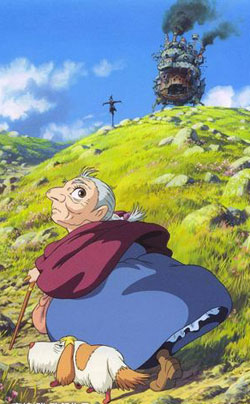
I rented Howl's Moving Castle because Spirited Away is my family's favorite movie. The kids love it, watch it over and over again and the adults like it very much as well. And outside the family, a lot of critics think it’s one of the better movies ever and it was the highest grossing Japanese film in history.

Myself? I've never watched Spirited Away. One of its main characters is a creepy old lady that totally freaks me out. I shudder every time I walk through the living room and see her on the screen. She is very, very disturbing and I want no part of any movie with a character like that in it.

So, as you can imagine, I was wary of Howl's Moving Castle and became extremely uncomfortable when very early in the movie a witch turns a young girl into an old lady. I was ready to bolt for the bedroom and the comfort of the drugs, alcohol and the computer, but I steeled myself and gave it a few minutes. Fortunately, it turned out that Sophie, the central character in the film, was not a creepy old lady. It took awhile to see it, but she was actually quite beautiful.

Ha ha, I bet your thinking, yea, another movie where the seemingly ugly character's inner beauty shines through in the end. Well, perhaps, but there is no glass slipper, no changing into a swan, no revalatory moment, no epiphany, no crescendo of strings in the soundtrack while everyone recognizes Sophie's inner beauty and they all live happily ever after. Howl's Moving Castle is far too sophisticated for that kind of movie staple nonsense. Hayao Miyazaki has proper respect for the intelligence and artistic sensitivities of children.

I say proper respect because both Howl's Moving Castle and Spirited Away are not movies you could pitch to a Hollywood studio as children's movies, yet children love them and happily watch them repeatedly. Yes, I know, that may be true of classic Disney movies, or recent Pixar films, but Miyazaki's work is significantly different than the standard American forumula. There are no cute sidekicks, no rousing battles, nor even tragic deaths á la Bambi.

Miyazak's work is about story and character, yet it goes deeper, it engages the child in a realm between dreams and intellect, in an abstract reality that only a few adult artists such as Miyazaki and Roald Dahl have been able to interpret but which almost any child can immediately understand.

Yea, you’d think that when a young girl gets turned into an old lady at the beginning of a movie that the rest of the film will be about how she tries to undo the spell and regain her youth. But such is not the case with Howl. There are scenes in which Sophie indicates she would like to have her youth back, but she’s not on a quest to achieve it and that plot-line is not the driving force of the narrative.

I wouldn’t describe any of the particular themes of Howl, and there are many, as the driving force of the narrative. The story is set in a European-ish land with towering Alps-like mountains in the background. The time is vaguely early twentieth century. The roads are populated by steam powered automobiles and slow-moving propeller driven flying machines fill the skies. A senseless and brutal war provides the narrative arc, but Howl is not a movie about war. Nevertheless, there is talk of war in the beginning and then the war begins and gets worse, taking its toll on the characters as the movie progresses. The movie ends when the war ends and the war ends as a result of the actions of the characters. Yet, as I said, the movie is not about war. War merely provides the external framework.

Howl, voiced by Christian Bale, is a wizard. Howl’s castle is, as the title indicates, a moving castle. It moves around the wastelands and is occasionally spotted by the townspeople who believe that Howl eats the hearts of beautiful young women. Sophie is a young, plain girl voiced by Emily Mortimer. She is turned into an extremely old woman voiced by Jean Simmons by the Witch of the Waste, who is indelibly voiced by Lauren Bacall. Calcifer is a fire demon voiced by Billy Chrystal who provides a particularly understated performance by his standards. Calcifer is enslaved by Howl and uses his power to heat, move, and hide the castle. Madame Suliman, voiced by Blyther Danner, is the King’s sorceress. Her dog is an important character as well. Turnip-head is a scarecrow who hops around and helps out Sophie at key parts of the film.

So what’s it about? Hard to say.There is a war, but it’s not about war. There are questions of beauty, but it’s not about beauty. There are issues of vengeance, but it is not about revenge. The themes of community, loyalty and betrayal are present, but hardly omnipresent. It’s a complex story told with genuine respect for its audience. You can come to your own conclusions regarding what it's about, but I think you'll find that even if it's about nothing at all, it's extremely good storytelling.

All of those themes are handled with quiet depth. Miyazaki never overtly draws attention to any of them. Almost everything that happens in the movie is open to a variety of interpretations. It bears repeated watching. It’s not like Pokeman. I don’t think the kids’ brains are rotting a little bit more with each viewing. The opposite is more likely true. As far as I'm concerned, they can watch it as many times as they want.

The narrative arc of the character of the Witch of the Waste is illustrative of the movie’s sensibility. Her growth and transformation as a character is one of the genuinely interesting elements of the movie. She is a fearsome monster in the beginning. Alternately beautiful and double-chinned scary she is contemptuous of Sophie who she describes as a “tacky little girl in a tacky little hat shop” and turns her into an old lady out of petty spite.

The next time we meet the witch is in a very strange scene where Sophie and the witch are walking up the stairs of the castle to see Madam Suliman. The stairs are steep and long and there appears to be some kind of magic spell that makes them exceptionally difficult to climb. As the witch climbs the stairs she huffs and puffs and sweats and begins to shrink. Her double chin quadruples until she is little more than a blob of jelly and it’s difficult to tell where her 16th chin ends and the rest of her body begins. Sophie taunts her as they walk up the stairs, saying how happy she would be to help if only she were younger, but the witch says she only knows how to make spells not remove them. But as the witch transforms into an ugly blob of huffing and puffing jelly, Sophie transforms as well. She goes from mildly taunting the witch to feeling sorry for her, even asking one of the King’s attendants to help.

When they make it to the top, Madame Suliman strips the witch of her powers and she becomes a helpless old lady. Suliman explains that that’s what she really looks like without the benefit of magic. I won’t give away the plot details at this point, but Howl shows up, hijinks ensue, and they escape the King’s castle. Sophie brings along the witch and becomes her protector and nursemaid. During this time the witch goes through another transformation. Although she remains old, she becomes beautiful, but as with everything else in the movie, her transformation is not that simple.

Note that with the witch’s transformation, two major characters have been transformed into ugly old ladies and become beautiful. And their beauty does not come from obvious changes in the way they are drawn. It comes from the way they act. Miyazaki pulls off the nearly miraculous feat of getting us to see the same thing in an entirely different way. And I stress again that there is no hammer blow involved. No character is saying “wow look at how the old lady has changed. These changes, and all the other important themes in the movie happen unobtrusively and naturally in the course of the narrative. And again, what Hollywood studio would even consider producing a movie with two ugly old ladies as main characters and no clear moral lessons?

Yes, dissertations likely will be written on Howl's Moving Castle, but don’t be afraid. It’s a pleasant movie to watch with your brain turned off. It is well-paced with no dead spots. The animation is consistently great and nearly transcendental in many scenes.

But I’ll give Miyazaki the last word:

"Personally I am very pessimistic," Miyazaki says. "But when, for instance, one of my staff has a baby you can't help but bless them for a good future. Because I can't tell that child, 'Oh, you shouldn't have come into this life.' And yet I know the world is heading in a bad direction. So with those conflicting thoughts in mind, I think about what kind of films I should be making."

Perhaps this is why he tells children's stories. "Well, yes. I believe that children's souls are the inheritors of historical memory from previous generations. It's just that as they grow older and experience the everyday world that memory sinks lower and lower. I feel I need to make a film that reaches down to that level. If I could do that I would die happy."

I ask if he feels he's managed that already and he chuckles and shakes his head. Nor does he feel that film can be employed as a force for good. "Film doesn't have that kind of power," he says, gloomily. "It only exerts its influence when it stirs patriots up against other nations, or taps into aggressive, violent urges."

This is a black diagnosis indeed. But then, inexplicably, Miyazaki's mood lightens. Perhaps it's the sunshine, or the cigarette, or the fact that the interview is almost over. "Of course," he relents, "if, as artists, we try to tap into that soul level - if we say that life is worth living and the world is worth living in - then something good might come of it." He shrugs. "Maybe that's what these films are doing. They are my way of blessing the child"

Yep.

I'm a consumer, baby, so why don't ya kill me


Don’t worry, if I don’t change my consumerist ways, my wife will take care of that.

But today was a bit overboard. I’m on a serious Hayao Miyazaki (宮崎 駿) kick and ordered the DVD box set of the 14 movies his studio has released. I’m currently working on a post about his most recent film, Howl’s Moving Castle, but it’s coming along slowly.

Then I read an article in the Guardian about Nouvelle Vague and am downloading their music off ITunes as I type. Apparently, they do Bossa Nova versions of classic underground 80’s music, which sounds like my kinda thing. I haven’t lost my appreciation for the lyrics of such songs as “Too Drunk to Fuck,” but can’t really stand the guitars for long stretches like the old days. And I love Brazilian music, though I generally prefer Tropical to Bossa Nova, it’s not like that big of a difference. So I’m optimistic.

The bands covered are:

1. Joy Division
2. Depeche Mode
3. Tuxedomoon
4. The Clash
5. PiL
6. Dead Kennedys
7. Sisters of Mercy
8. XTC
9. The Cure
10. Modern English
11. The Undertones
12. Killing Joke
13. The Specials
14. Josef K.

The snotty reviewer at Amazon described it as “ironic dinner music for the new millennium.” I would never use the term “new millennium” and the music’s pretty much as ironic as it gets in it’s original form. Frankly, I’m just hoping for some good dinner music. I’ll let you know.

Thursday, June 29, 2006

Chucking out the competition

Anyone who read my Mermaid Day post below may be interested in checking out the Village Voice photographer’s coverage of the event. My first thought was that it was pretty weak. Then I thought, well, it’s tough to go to an event you’ve never covered so I shouldn’t be so fucking critical. The photos aren’t technically bad. But my feelings of collegial warmth didn’t last long. The Voice photos show only one aspect of the event. I’m not even talking about art. They fail as journalism. At best they are tourist photos. It’s probably more accurate to describe them as publicity photos.

And that’s what photojournalism has mostly become. I worked at a photo agency for several months before the 2004 elections and saw literally tens of thousands of photos come over the wire. The elite photojournalists covering the campaign happily framed their shots just like the set designers anticipated. Without exception they provided the campaign with heroic images of the candidate against dramatic backgrounds that were every bit as scripted and framed as the biggest budget Hollywood movie. The Mermaid Parade is not so well-staged, that’s a big part of its beauty, but the photographer’s intent was the same.

Am I any better? Perhaps not, but this particular post isn't really about me.

And all Mermaid Day photos are interesting on some level. If you want to see more, here’s 1521 Mermaid Day photos that people have uploaded to Flikr.

Tuesday, June 27, 2006

Bad Things in the Forest of Light and Shadow


I watched Rashomon, the Great Movie Classic by The Legendary Director Akira Kurosawa again and didn’t like it any better the second time. I thought the story was weak and the acting bad. Visually, I thought it was very good and the sound was well-done, but for me that was not enough to carry it. So that’s my shallow review of a film that is considered by leading critics to be one of the great films of all time. What can I say?

Well, for one thing, Rashomon is one of those films that is more interesting to read about than to watch. The Wikipedia link above provides some great examples of how people can spend way too much time analyzing a piece of art. Kurosawa says that light and shadow were main characters in the film, but he says nothing about what their characterizations signified. One prominent critic finds that light represents the bad and shadow the good whereas another prominent critic finds just the opposite and both can make coherent arguments to support their position. Me? Cool use of light and shadow, is all I have to say about it. I don’t care what it means and would like to think that Kurosawa didn’t settle on some black and white meaning either. If he did, he at least had the artistic skill to leave it open to interpretation.

The story is told by four separate characters -- the murderer, the dead man, his wife, and a man who claims to have witnessed the crime, and none of the stories are the same. The plot is simple. A dead body is found. A criminal is apprehended. How did the dead man get that knife in his chest? That’s the mystery.

What does it mean? Well, duh, you may say, that story structure’s been done a hundred times. Like everything else, it has even been referenced in the Simpson’s (Marge: “you liked Rashomon.” Homer: “That’s how you remember it.”) Is it worth anything that Kurosawa did it first in Rashomon? Again, it’s interesting to read about, but watching the movie, who really cares?

Same thing with the cinematography, but I answer the question differently. Some of the techniques used in the filming of Rashomon were revolutionary. Is that worth anything? Again, it’s interesting to read about, but watching the movie, does it matter? Well, it doesn’t matter who did it first, but it matters that it’s done so well. The forest scenes where the camera is pointed directly into the sun are incredible. The rain scenes at the gate are insanely good as well. Rain doesn’t show up on film when you point a camera up against a grey sky, so they mixed black ink in the water so the rain would be visible. Interesting to read about, but when watching the movie, the visual element is all that matters, and the downpour at the gate is sublime cinematography.

It’s just the opposite with the story. If we analyze it like English majors, the story is great. It plumbs the emotional depths of human tragedy, at least from a male perspective, depicting one of our worst nightmares. A man and his wife are waylaid by a bandit. He is tied up and she is raped in front of him. Then he is murdered. We’re never sure what the sequence of events were, but each of the tellings is heartbreaking in its own way. In one, the woman enjoys the rape and asks the bandit to kill her husband. In another, the man wants nothing to do with her because she was raped. In the other, it’s a comedy of errors. Then the ending goes off on a totally different tangent and you can make of that what you will.

I’d skip the critics though, myself included, and decide for yourself. If you want to read something intelligent about it, I recommend going straight to the source. Before filming began, three of Kurosawa’s assistant directors came to see him. They had read the script many times without understanding it and asked him to explain it for them.

“Please read it again more carefully,” I told them. “If you read it diligently, you should be able to understand it because it was written with the intention of being comprehensible.” But they wouldn’t leave. “We believe we have read it carefully, and we still don’t understand it at all; that’s why we want you to explain it to us.” For their persistence I gave them this simple explanation:

Human beings are unable to be honest with themselves about themselves. They cannot talk about themselves without embellishing. This script portrays such human beings–the kind who cannot survive without lies to make them feel they are better people than they really are. It even shows this sinful need for flattering falsehood going beyond the grave—even the character who dies cannot give up his lies when he speaks to the living through a medium. Egoism is a sin the human being carries with him from birth; it is the most difficult to redeem. This film is like a strange picture scroll that is unrolled and displayed by the ego. You say that you can’t understand this script at all, but that is because the human heart itself is impossible to understand. If you focus on the impossibility of truly understanding human psychology and read the script one more time, I think you will grasp the point of it.

Yep.

Monday, June 26, 2006

Today's Featured Blogs

I recently discovered the “Next Blog” button on blogger and now I spend a small portion of my downtime clicking to random blogs. I only read a few blogs on a semi-daily basis, all of which are left-ish political, the majority of which are funny. And sometimes I click on the links at Eschaton where I find little more than a political circle jerk, everyone discussing the same topics, typically the White House talking points, from the same perspective. That’s all fine and good. Everyone should have essentially the same opinion on what that cabal of lying murdering scum we call our government are doing to this country and most of the rest of the world. I’m happy, in fact, that people care enough to write about it and find an audience. And although it saddens me that the best of the left-ish bloggers are doomed to disillusion and failure, and that the worst of them will turn into that which they most hate, I sincerely wish them all nothing but success.

Still, I need more. I need art outside of the political. I need literature beyond the noble tradition of skewering the puffed up and the powerful. And these are the things that I find when I click the “Next Blog” button. Oh, not every time, to be sure. Not even once out of fifty, but sometimes it happens. Sometimes I find great writing. Sometimes I find art. Always I find humanity. Out there among the hordes, the forty billion or so people who have started their own blog, usually having no idea what to do with it, the people who put their diaries on-line, hoping, fearing, that anyone will read them. Finding that rare combination of people who have interesting stories to tell and can express themselves effectively is, for me at least, a genuinely awe-inspiring experience.

Anyway (removing finger from back of throat), today was a good day. It’s possible to go for weeks without finding anything the least bit interesting and then today I get two great blogs in a row.

Green Eyed Brunette is a southern California woman. She is having problems with her marriage. She and her husband are seeing a counselor. She likes to write about sex. She writes very well and her little escapade with vasodilators is hilarious.

That horrible fucking gel ignited me on FIRE (not literally, but it felt like it) and since it was on my lips and I was wrapped around his cock…you guessed it. Let’s just say that it was a very disappointing experience for all involved and ruined good night of sucking him off.

I find the whole marriage counseling thing interesting. I’ve never seen the point of it myself and can’t imagine how it could ever possibly work, but I guess it must for some people (mustn’t it?). And I especially don’t see the point in it if the couple is young and there are no kids involved. I suppose there could be financial issues, or religious nonsense, but for the most part who gives a fuck? Of course I know that the fact that I don’t see something doesn’t mean it isn’t there, just saying...

And as a neutral observer, I have to say the marriage prospects don’t look good. The guy doesn’t want to have sex very often, but wants a kid. I always tell people who are having relationship problems that they should get married, cause that might solve their relationship problems, and if marriage fails, they should try having a kid. It’s scary how many people actually take that advice.

Green Eyed Brunette reminds me of Some Watery Tart, although I’m not so sure t hat they really have that much in common beyond being southern Californian women, which reminded me of my experiences with southern Californian women. Those experiences were mostly painful when I was just a seventeen and eighteen year old from Hicksville run away to L.A., but in later years I’ve known several who I learned to like quite a lot. I am not the kind of guy that your typical southern California woman is attracted to as a lover or marriage material, but we can get along quite well when they are married to good friends of mine or in a Platonic relationship. I don’t mean Platonic like laying in bed talking about Plato after sex Platonic, but the kind of Platonic where people don’t even think about having sex together.

In the very next blog I found Gotta Be Me, who has a few relationship problems of her own. Let me pause here to note that I am somewhat uncomfortable doing the “Next Blog” thing and reading the intimate details of people’s lives and then sharing them with a wider audience. On one level, we can say that anyone who puts the intimate details of their lives out in such a public space has no reason to complain when others read their thoughts and link to them, since linking is the nature of the blogosphere. And although that is true, I am not an asshole in that regard and have already deleted a few posts when asked. And I have my some morals in this area. Although I have spent a lot of energy ridiculing right wing idiots on the internets and elsewhere, I have no desire whatsoever to ridicule the people like Gotta Be Me whose writing I find so intriguing. That said, I’m a little uncomfortable with linking to her particular relationship problem because it is, frankly, a bit ridiculous.

Still, that is not my point. For me,Gotta Be Me’s relationship disaster is a good story and a good story told well. It’s not worthy of a novel or a screenplay, but it could certainly be a very funny or moving scene in a novel or a screenplay. And the deeper you read into Gotta Be Me, the more interesting it gets. I never would have suspected that the naive-sounding young girl who made the unfortunate marriage proposal on a whim could have a gonzo-violent crystal meth history.
Two years ago on my birthday (July 2nd) my boyfriend at the time, who was also my drug dealer, and I were living together. We were out of drugs and I wanted him to take me out to dinner. Of course, he did not want to get out of bed because there was no meth to give the needed energy to step out of the bedroom. After a few hours of checking around we discovered that there was none to be had and I continued to harp on him, Please, Please get out of bed and take me somewhere, it is my birthday, please?

...I stormed out of the house, determined to have a happy birthday anyway, with or without him.

Along the way, I immediately starting getting phone calls from him.... The messages were horrible. It was like something out of a movie:

"Do you hear me bitch? Do you f-ing hear me? Do you hear that noise" (crashing noises in the background)

"That is your precious piano"

"You fucking bitch, you fuck with ME, see what happens?"

"You just couldn't leave me alone, could you? Well, happy birthday bitch!"

Now that is a great story and she tells it very well. It could easily be a scene in novel or movie and I think it could even be the basis of a short story or a play or possibly a film.

But of course these stories are not fiction, they are real life with real people suffering and overcoming, or not. It is me, and through me, you, who are the voyeurs, the detached readers of these narratives. I think it’s a great thing that people write their experiences, and that they write them well. Is it right that we read them? And comment on them?

You tell me.

Sunday, June 25, 2006

No Tuna -- Mermaid!


Yesterday was the annual Coney Island Mermaid Day Parade. I discovered it by accident the first summer we lived in New York. I was with the kids at the beach when all of a sudden a large group of people in decadent sea creature costumes and a band with a lot of horns and drums playing funky Germanic carnival music from the twenties swarmed over and around us and started dancing in the water while a fat guy dressed like Neptune held up a sign that said “Summer.” I forgot all about the kids and took pictures for the next half hour. Man did I feel bad when I realized I’d lost my children among a bunch of drunken revelers, but I eventually found them splashing around with some girl dressed as a giant lobster with tits for eyes, so all was well. I’ve photographed the Mermaid Day parade ever since.

Usually I take still photos but this year I did video and committed to producing a half hour of television for one of the local public affairs shows. This will be a good test of my incipient video skills. I knew the event, knew what to expect, and knew where people would be, and when. I had a plan for what I wanted to do and executed it as well as I could. Oh, it would have been nice to have a crew and a couple cranes, and some sound people, but I don’t have any of that and am past the point of getting paralyzed by my technological limitations. I just go out and shoot the damned thing, whatever it is, and make of it what I can.

Anyway, we’ll see how it turns out. I logged the video this morning and am capturing it on a different computer as I type. I took a lot of chances creatively and I see clearly all of the things I missed, and the editing will be a chore, but I’m optimistic that I captured the spirit of the event. Whether or not the public affairs show in question shows it or not is another matter since the spirit of the event is decidedly Bacchanalian. Or more to put it more bluntly, there is a lot of T&A.

And that brings me back to the never-ending question of photographic ethics. I genuinely love the Mermaid day parade and believe that it is an important part of the history of Coney Island, of Brooklyn, of New York City, the United States, and the human species, as well as the planet earth and the entire universe. For those humble reasons, I honestly believe that it needs to be captured in pictures so that future generations can know of it and although tI have no doubt that others are doing a bang-up job of capturing the event for posterity, I can’t rely on that belief so must create my own record, for the benefit of mankind. Not that I wouldn’t mind a little personal benefit, but that’s not my primary motivation.

But sadly, photographers are totally fucking it up. The attached picture of the dirty old man snapping a picture of the pretty girl’s ass only begins to tell the story. There are literally hundreds of guys with cameras focusing on women’s tits and asses. I always meet and chat with the parade participants at the beginning before they have felt the barrage of photographers and they are happy optimistic people. By the end they are mostly traumatized. There are a few who love being the center of attention, but for the most part the people who are there one year will not be there the next.

Yet I am one of them. I take hundreds of photographs and for the participants am probably indistinguishable from the perverts. That’s probably not quite true. I am likely distinguishable because I am not skulking around taking pictures of people’s asses, I am in the thick of it, taking pictures of whatever is in front of me, which is often tits and asses. That is the nature of the event and a lot of the people probably think that I’m the worst offender out there.

I don’t know if I can explain it in a convincing manner. I do not see the event with prurient eyes. I see it as beauty, as art. as a kind of life I find eminently satisfying. The beauty I see is in the faces. It’s in the costumes. It’s in the human interaction. Not in the crack of the ass or the curve of the breast. There is not the remotest chance that I am going to masturbate to any of those photos, which is what I imagine most of those guys must do. If I am successful, my eyes will mist over, or I might even shed a tear if I’ve got the proper buzz on, at the human beauty of it all. When I photograph a semi-nude woman, or man, the only sexuality in the image is whatever she or he brings to it. My camera is neutral in that regard.

If you have read this far, you can probably tell that I think a lot about these issues. Last year I was one of the asshole photographers. I consciously planned to be one and I carried it through. I photographed women’s tits and asses as if I cared, as if that’s what I was about, and I genuinely felt like shit. I also photographed the other photographers taking pictures of T&A, as well as the general beauty of the event. And the final product was meant to demonstrate the degeneracy of that kind of photography, but as far as I can tell everyone who saw it missed the point and thought I was just into nudity. What can you do? The photographs have to speak for themselves. I think that there would be people within a wider audience that would appreciate them, but a wider audience is not something I have.

Anyway, I won’t have the bandwidth to put the entire half-hour on line, but I’ll try to carve out a five to ten minute chunk in case anyone is interested. If you’re interested, stay tuned. I like the still photography for what it is, but the movement and sound in the video capture another few layers of reality.

Marching Orders

Speaking of Doormatocrats, Hillary Clinton makes a joke in the New York Times:

She also labeled the House of Representatives as "a dictatorship of the Republican leadership," where individual members are all but required to vote in lock-step with the majority's agenda.

It’s funny because she was marching lock-step with the majority as she said it. Not that anybody ever claimed she couldn’t march lock-step with the majority and chew gum at the same time, but still, it’s a wonder to behold.

Thursday, June 22, 2006

Whatchu got

Atrios writes:

Republicans really believe that by promising to stay in Iraq forever they'll win elections. I do think the politics of Iraq are a bit tricky, even though the press completely ignores polls showing that the Democratic positions are in fact popular, but it's up to Democrats to make the public understand that this is in fact what the Republicans are gloating about.


Make no mistake. I like Atrios and appreciate his effort. I check out his site pretty much every day. And although I don’t visit quite so often, I even like the earnest young folk at Daily Kos. In fact, I like pretty much everyone out there in left blogastan. So I don’t take any pleasure in the fact that their dreams will never come true. I’m not saying that they are ineffectual. That would be sad, yes, but hardly tragic. No, tragically, they are worse than ineffectual. Don’t misunderstand. I tell you this from absolute knowledge. I can see the future.

But more on that later. Here in the present, the Senate’s 86 - 13 vote against withdrawal from Iraq tells us everything we need to know about the state of the party. I say party in the singular because the Democrats are no more of a political party than the Washington Generals are a basketball team. For those of you unaware of the Washington Generals, they are a fake basketball team that plays the Harlem Globetrotters in venues all across the country. They are not really an independent team that plays to win. They are employees of the Harlem Globetrotter corporation who are paid to lose, and lose in such a way as to make the Globetrotters look good.

Same thing with the Democrats, hereafter referred to as Doormatocrats. They fulfill the same corporate role as the Washington Generals. They make a few shots, keep the score close, maybe even hold the lead for a time, but when it matters, they’ll stand idly as Curley or Meadowlark dribble circles around them and go in for the winning lay-up. And if corporate interests are deemed to be at stake, they won’t even make it close. They will lay down on the porch with a black Welcome emblazoned prominently on their backs.

So when Atrios and our other liberal friends wistfully opine that the Doormatocrats could win if “only they could make the public understand...” it’s a bit pathetic. The Doormatocrats are not even going to play meaningful defense, much less lead.


Wednesday, June 21, 2006

Fat Man and Blunderbuss


My parents were in town this past weekend and the whole family drove up to West Point to take the tour. It’s not the first time I’ve been there. One time a friend and I took a boat up the Hudson to see the Army vs. Air Force game. The football game was much better than the weekend tour because we could walk freely around the grounds and the cadets were out in their cute little grey uniforms. I didn’t care a whit for the football game itself, but the pageantry was interesting. This time we were limited to a tour bus, the gift shop and a museum.

Understand, West Point is one of the more beautiful spots on the Hudson. It looks like a medieval castle complex on a hill above the river. The buildings are made of grey stone from local quarries that complement the cute grey uniforms of our future military leaders. Familiar names are on statues and plaques throughout the campus. The view of the river valley from the north end amphitheater is spectacular, especially in the fall.

Nowhere did I see the names of any Confederate officers. I was curious how they were viewed by the guardians of West Point’s history, but did not ask because my father is a big civil war buff and something of a wingnut. To be a happy family, we must avoid any talk that could be remotely considered political and anything to do with the civil war falls into that category. Nevertheless, I was happy to imagine that the lack of statues or memorials to the likes of John Bell Hood or Robert E. Lee was due to the fact that they were traitors responsible for hundreds of thousands of deaths and problems that plague us still. It’s a pleasant thought but I don’t really know. Next time I’m there I’ll ask.

I was a bit uncomfortable taking my son there. He’s only seven and boys can be impressionable at that age, especially when it comes to violence. And my fears were immediately, and comically, realized. They had big screen television showing a propaganda video in which young men climbed walls, forded streams, jumped out of airplanes, and fired all manner of guns. He’d seen it two times through when I walked over. He turns around, face beaming, and says “dad, I want to join the army!” Of course you do Bub, I want to say, and you can walk over my dead body on your way to enlist, but I laugh and let it go. Other kids are having the same reaction, but their parents are encouraging them. Honestly though, as mentioned in an earlier post, I have some respect for our officer corps and even though it’s not a future I wish on my kids, I hope that good decent people continue to attend West Point where by all accounts they get a very good liberal arts education.

I like to think that they should educate the enlisted men as well instead of turning them into mindless killing machines. I understand the reasoning, but would be interested in hearing knowledgeable people discuss the subject. Is it not possible to have mindful killers? Would that necessarily make us weaker? You know I think that a major reason for our failure in Iraq is directly tied to the behavior of the troops. I think that the day-to-day humiliations they inflicted on Iraqis fed the insurgency when we actually did have a chance for a decent outcome and ultimately made us weaker than if we would have taken a few more losses up front and treated people with respect . Perhaps we’d have a lot fewer dead now and terms like “Haditha” and “Abu Ghraib” wouldn’t be dogging us into an ever more dangerous future, if the enlisted men were expected to be as enlightened as the West Point graduates.

We ended the visit on a weird and disturbing note by visiting the museum. It started out okay. All of our wars, little and big, are represented in a glass case or two and winding through the displays gives a nice, albeit narrow, look at the history of the United States. But I think we all became a bit sick to our stomachs walking through the floors dedicated to weapons. Although many are beautiful for their craftsmanship, I don’t think any of us could get away from the fact that their purpose was to kill people. Although some, such as the blunderbusses or the atomic bomb, are worse than others, all of them are brutal and primitive by their very nature. No sane and decent human being would want to be on either end of one of them. Even my uber-patriotic pop made a wry comment. And my son has yet to say anything about wanting to join the army since that little tour.

Tuesday, June 20, 2006

Shallow Born Critic


I read Killer Instinct, the story of the making of Natural Born Killers by Jane Hamsher on the recommendation of a commenter at Alicublog.

Natural Born Killers is one of my favorite movies. No that doesn’t do it justice. Natural Born Killers is one of the greatest movies of all time. It is great on every level. The story is great, the cinematography, the acting, the soundtrack, the editing, you name it.

And it wasn’t an accident. Everyone involved in the film went for greatness. They went for it on every level, threw caution over the cliff and took a flying fuck at the pantheon. I’m not going to regurgitate the plot or link to any reviews. If you haven’t seen it, see it. If you saw it and were disgusted, see it again with an open mind. That’s all I have to say on that level.

Although I’ll happily put Natural Born Killers up there with Apocalypse Now or A Clockwork Orange, I’m not going to claim that Jane’s book is War and Peace or anything, but it’s a great read. I don’t usually go for those Hollywood insider or how the movie was made stories, so I can’t compare it to any other book. If anything, it reminded me of Hearts of Darkness, the film about the making of Apocalypse Now, but I wouldn’t quite put it in that category.

Nevertheless, it is a page-turner and provides interesting portraits of a great number of Hollywood characters. And it’s good on a level beyond the day-to-day story it tells, because we recognize universal human traits in the Hollywood snivelers and other flawed characters that Jane so thorougly dissects. It helps the interest level that some of the these snivelers (Quentin Tarantino) and flawed characters (Oliver Stone) are so well-known.

Yea, I can’t deny it, I get a kick out of learning that Tarantino is every bit the low life talent-challenged asshole he appears to be on tv. But I was sorry to see what an ass Stone can be. But at least he had his noble moments. I was genuinely saddened that Trent Reznor was such a putz in the story, taking credit for someone else’s work.

But hey, that’s the stuff of drama. Can the hero overcome his faults and succeed in the end? That’s what keeps us watching. And although these famous people, as well as the losers in the story, act out their flaws in over-the-top Hollywood performances, the same shit happens every day among the cubicles and factory floors. People are people -- the vain, selfish, venal and back-stabbing will always be among us, and sometimes we manage to produce great stuff nevertheless. And so do they.

Before reading the book, I had forgotten about the controversies surrounding Natural Born Killers, the copy cat killings. the questions of artistic irresponsibility, or complicity in the murders of innocents. This was a bit strange because I was personally involved in one of those incidents. Around that time, my former step-brother and his girlfriend went on a cross country killing spree, ended up killing my best friend’s aunt and uncle in the Arizona desert and stealing their RV. But unlike Mickey and Mallory riding the highways in their RV at the end of NBK, poor Toney died in a shoot out after a short, laughable RV chase with the cops outside of Barstow. The future wasn't so kind to him.

But the comparison came only from the press. It’s very unlikely that Tony had ever seen Natural Born Killers. My friend whose aunt and uncle were murdered knew enough about all the parties involved to know exactly how it went down, and we’re sure there was no artistic inspiration at the bottom of it.

Quite the contrary, that story illustrates one of the reasons that Natural Born Killers is such a great fucking piece off art. I remember Tony when he was 9 years old, everyone had gone way overboard to give him a great Christmas because he had been so deprived up until that point. When he walked into the living room and saw all of those presents, his face looked just like the boy who played young Mickey in the movie and on other days when his asshole father yelled at him, or beat him, that hurt that was captured so poignantly in the film was written all over his face. I wouldn’t describe him as a natural born killer though. Natural made killer would be much more accurate, and the same is true of Mickey and Mallory, but that fact takes nothing away from the film. Ya gotta give em some dramatic leeway.