I just finished my first reading of Paul Auster’s New York Trilogy. I had never read Paul Auster for a couple of reasons.
First because I had the impression that his prose was dry, pretentious and literary. I don’t know why I thought that. Maybe from watching Smoke.
Second, he was highly recommended to me by a couple of people I reflexively didn’t respect much. That’s shallow and wrong of me I know. They are both well-read younger guys with that superior young guy attitude. Intellectually I know better than to let that bother me since I had the same attitude in spades. Ultimately I was able to overcome it and picked up the book.
Much to my surprise Auster wasn’t dry and pretentious at all. The New York Trilogy is deep literature that is very enjoyable and easy to read.
But I’m afraid that’s all I’m going to be able to tell you about it. Although I’m willing to play the critic on a few movies, there is no way I’m going to take away any of the pleasure you may get if you read those books. To discover what is going on in the many layers of the narrative provides much of the enjoyment of reading them. I still haven’t read anything about them, or Auster.
I want to read a lot more before I let others influence my opinion, but I do look forward to that day. Although Auster is fun and easy to read, he is tricky and I can easily see that there are a lot of hidden things and multiple ways of interpreting them.
So I recommend New York Trilogy. Go for it. And go for it in virginal ignorance of Paul Auster if you still can. That’s my advice.
Friday, August 25, 2006
Locked Rooms in a City of Glass full of Ghosts

Shape of things
Barbara Ehrenreich whomps on Wal-Mart’s ass, as is her wont.
When Wal-Mart workers can't afford health insurance or new school clothes, the whole working class begins to flail. Furthermore, the Wal-Mart business model increasingly betrays what was once the operating principle of American capitalism, as explained by Henry Ford the First: You've got to pay your workers enough so that they can buy your product; that's what keeps the system going. When the American majority can't buy the very goods they manufacture or sell, that system is cruising for a bruising.
I’ve seen a lot of this myself. By the nature of my work, I’ve spent a little bit of time at a lot of companies over the past few years and, although the people I work with are not quite as low on the economic ladder as Wal-Mart employees, it’s easy to discern the same trends.
Companies are under constantly increasing pressure to cut expenditures and from what I’ve seen they do not go about it intelligently. All too often the decisions on who or what to cut are based on petty office politics rather than competence. And as the more competent people are laid off or bail out, the product suffers and profit declines. Meanwhile, those remaining are required to work ever more hours for which they are rarely paid. Either they are salaried workers or hourly types being offered comp time in lieu of overtime. Of course that comp time is in no way officially tracked and rarely collected. And raises are limited to 3 or so percent annually and promotions are generally out of the question.
Meanwhile only speculators or trust fund babies can afford to buy a house. I made the mistake of calling a realtor about a house I saw the other day. It is an old house, early twentieth century, fairly large but not particularly well built. It needs repairs, has a very small yard, sits near a noisy freeway in a generally ugly neighborhood in a not trendy part of the city. 1.6 million. What’s that in monthly payments? $11,000 dollars. My sister bought a house just like it in a small town in Indiana for $29,000 total a few years ago. People making $80,000 with a couple kids in New York can’t begin to afford a house and have to live paycheck to paycheck just to make the rent and very basic living expenses. And I’m not even talking about Manhattan, or even trendy Brooklyn.
And most of these companies that aren’t paying squat are very profitable. All of the squeeze is to make ever higher returns for the shareholders and top management, most of whom are arrogant sociopaths, many of whom are incompetent at everything besides gaining power.
Ah well, what can you do? Live well and prosper, emotionally at least, while we can. How will the inevitable crash play out? I guess we’ll just have to see.
Monday, August 21, 2006
Shit for brains
Via Atrios:
According to CNN just now a Time poll for a hypothetical McCain-Clinton race has it at 49% McCain 47% Clinton.
First the standard disclaimer: I know, I know, anyone is better than Bush and any Democrat is better than any Republican. Still, if our leaders are the brain cells of our nation, we sure got shit for brains.
It’s all to easy to imagine McCain vs. Hillary. McCain will advocate putting a force of 400,000 in Iraq and gearing up the draft in order to invade Iran and Syria. Hillary will boldly compromise, arguing for a force of 200,000 and a partial draft in order to invade either Iran or Syria.
Yep, that’s the future. Republicans show real leadership with insanely stupid ideas and the Doormatocrats boldly compromise. It sucks to see the future.
I shit bullshit, who shit bear shit?

I was roped into hitting a happy hour with several of my colleagues today and had one of the strangest social experiences I can recall. One of the other project managers, let’s call him Bob, told me about how his father died. I’d chatted with him a few times since starting the job, but we had never had anything remotely resembling a heart-to-heart talk and all of a sudden he guzzles three healthy Manhattans and lays this shit on me.
This is what he told me. When he was 10 years old he was camping with his dad in western Montana when they were confronted by a big black bear. His father pushed the boy behind him and started jumping up and down and barking like a dog to try to scare the bear. The bear rushed them. The father shoved the boy away and yelled for him to run, then tried to duke it out with the bear and was gutted. Bob escaped but was tortured for years because he ran away and left his father to die. For what remained of his childhood he fantasized about killing bears. When he was in his late teens he began to hunt them. Then he learned that he could make a lot of money selling their gallbladders, getting up to $500 a gram, he says. He kept poaching bears into his mid-twenties when one day he realized that he had forgotten his purpose in killing bears and was doing it for the money rather than for his father. Then he started a dot.com but was unable to raise any serious VC money in Montana so he moved to New York and blew his savings. Next thing he knows, he’s data mining. He’s had a fourth Manhattan as he tells this story and is starting on his fifth, says I remind him of his father.
Okay, I say, that’s really tragic man, gotta be going. The job was weird enough before that. Anyone out there want to hire me?
Bringing it all back home
From the Guardian:
The victim's name was Abeer Qassim Hamza al-Janabi. Abeer means "fragrance of flowers". She was 14 years old. According to a statement by one of the accused, the soldiers first noticed her at a checkpoint. On March 12, after playing cards while slugging whisky, they changed into civvies and burst into Abeer's home. They killed her mother, father and five-year-old sister and "took turns" raping Abeer. Finally, according to the statement, they murdered her, drenched the bodies with kerosene, and set them on fire. Then the GIs grilled chicken wings.
The defence already pleads post-traumatic stress disorder
Yea, post-traumatic stress disorder, gotta be a lot of that going around. And you know what they say about what goes around...
Sunday, August 20, 2006
Yea, peace would be great, but what about the Benjamins
The Congressional Research Service, Congress’s nonpartisan public policy research arm, estimates that our invasions and on-going wars against Iraq and Afghanistan are costing roughly $8 billion dollars a month. That’s close to $100 billion a year.
Just ask yourself, better yet ask your elected representatives, candidates in the next election and media outlets if we wouldn’t be infinitely better off with Osama bin Laden in an orange jumpsuit in The Hague, Sadaam Hussein impotent and surrounded in his castle in Baghdad and $100 billion a year being spent on education, health care, and other pressing needs?
One of the first research problems we could fund would be to find out why so many people who have dug themselves a deep hole and want to get out of it are pathologically unable to grasp the simple fact that the first step to getting out of the hole is to stop digging. Develop a pill to cure that particular pathology would be a great start to a better world.
Murder's what you want...
Well, then murder’s what you’ll get, duh. And probably a whole lot more of it than you bargained for.
But our “leadership” has lost sight of that oh-so-basic fact of life. Today’s example is an article in the NY Times that reports Israel’s goal of killing Sheik Hassan Nasrallah. The Israelis do not even argue that killing this man will solve any problems. It is for revenge, nothing else.
“There’s only one solution for him,” said an Israeli representative, “This man must die.”
Well, no, there is another solution. If there is reason to believe he has committed crimes, he could be arrested and tried in a court of law. That’s how civilized societies handle these things.
And there is a reason for that. The act of murder as a tool of revenge is worse than ineffective, it is counter-productive.
I know it’s difficult for the idiots running our country and their lapdogs in the so-called opposition party or the media to understand, much more so for their followers, but if it’s okay to murder other people’s leaders who are involved in military operations then it is okay for them to kill yours. The same principle holds for torture. If it’s okay for our country to use torture on another’s soldiers, then it’s okay for another country to torture our soldiers.
But murder and torture are not okay. Not for us, not for anybody. Fortunately, there is a very easy way to stop this insane cycle of violence. Just stop. That’s all we need to do. At any moment, we can simply stop it. Nobody is making us create these crimes. Many people say that it would be impossible to stop, but that’s not true. It would be just as easy as it was starting it, possibly easier since historically we have been more about the rule-of-law than wantonly violent and counter-productive retribution.
But alas, we have no opposition party or independent media willing to make such an obvious argument. Instead, we are told that revenge and murder are a good thing, a means to a good end. Many people who write on the internets are already advocating a “final solution” for those who oppose us (and their families, neighbors, countrymen, et.al). And some of these people even make it onto television or get quoted in what were formally respectable publications.
When a society’s discourse begins to plumb these moral depths, the bad things they so ardently wish for are likely to happen. Historically, when societies go insane with bloodlust they only see the errors of their ways when they end up on the receiving end. And if we don’t change our ways, the receiving end is where we’ll be. Whether it’s in two hundred years or 10, that kind of blow back is inevitable.
Saturday, August 19, 2006
1973 Redux

I saw the New York Dolls last night at the South Street Seaport. When it comes to great shows, I'm a fan not a critic, so about all I can say is that they were fucking great.
This was no lame-ass reunion bullshit. This was a killer fucking rock & roll band. The crowd was huge and into it, even singing loudly along with the chorus of "Pills," a Janis Joplin cover, and "Human Being." The band looked great from a distance. In retrospect I was surprised at Syl Sylvain's talent on guitar. I guess it wasn't Johnny Thunders playing all of those solos. Steve Conte was good on the other guitar and the new bass player and drummer rocked like the days of yore. Johansen was energetic and clearly enjoying himself. His vocals and harmonica playing were strong.
The stuff off the new album fit right in with the old stuff, which was incedible cause that almost never happens. There was no let down in the energy of the crowd or the quality of the show. Someone unfamiliar with the Doll's catalogue wouldn't have been able to tell the difference. "Punishing World" was particularly great. A rousing "Dance Like a Monkey" ended the main part of the show. My only disappointment was that they didn't play "Running Around."
And some of the old stuff was transcendental. I wasn't around to see any live shows in 1973, but I've seen Johansen perform a lot of these songs in solo shows and they're all on the DVD from the London reunion show, but none of that was remotely as good as last night's show. They did the aforementioned "Pills," which had the crowd screaming, the show started out with "Looking for a Kiss," then there were such standards as "Jet Boy" and "Puss N' Boots." The first encore was an ecstatic version of "Personality Crisis" and the second was a killer "Human Being." The crowd would have happily stayed for the rest of the catalogue, but unfortunately the show was over.
To repeat what I said in the post below, I haven't heard Rock & Roll like that for ages. Even back then shows like that were few and far between.
Tuesday, August 15, 2006
2006
I’ve been meaning to write more about work. It’s not that I think the horrid details of my pathetic career would interest anyone, but it is interesting how my jobs serve to illustrate much that is wrong with our culture and economy. I’ve experienced most of those headlines you see – dot com death spirals, mass layoffs, takeovers by international investor groups, et. al. – in my wanderings from company to company over the last few years and now I’m on the cutting edge of data mining and consumer profiling.
Yes, I’d like to tell you more about it, but not now. I’ve been going through another round of training this week and just thought I’d share this one small observation. The trainer constantly uses words like “brilliant” or “awesome” to describe the most mundane occurrences. If everyone manages to turn on their computer without spilling coffee on it he gushes that we are all “brilliant” and our skills “awesome.” On and on.
And I know this trend is widespread and has been going on for awhile. “Awesome,” for instance, has been overused for years.
I suspect this is all related to the culture of self-esteem we read so much about. Apparently many kids are brought up receiving sycophantic praise for any little thing they do so I imagine that’s the only way they know to communicate. I guess there’s little harm in it other than further debasement in the way we are able to describe our world. What more is there to say when being able to chew gum and walk at the same time inspires awe and is practiced by the brilliant?
1973
I’m just on my third listen of the new New York Doll’s cd, One day it will please us to remember even this. It’s a great Rock & Roll record. It would be a great Rock & Roll record in any era. In this one it’s the only Rock & Roll record as far as I can tell. Rock ain’t dead yet, but looking at Johansen, I think it’s fair to say it’s getting pretty old.
One day it will please... is fresh, unlike most reunion records. I suspect that is because David Johansen has never stopped working. He played the Bottom line every couple of months for I don’t know how many years as either Buster Poindexter or as himself with the Harry Smiths. I even saw him a couple times at a defunct blues bar playing his solo material and some Dolls tunes with his long time collaborator Brian Koonan and a bar band. So he is not coming back. He never went away.
Sylvain Sylvain is the only other surviving member of the original band and Johnny Thunders wild guitar is missed, but the record is a legitimate Dolls record, not another Johansen solo project. So far Running Around and Punishing World are obvious classics, but I feel quite a few others can grow on me.
But enough of this crap from me. If you want to read a real review, go here.
In the meantime I’m having fun. Best Rock & Roll I’ve heard in ages.
Sunday, August 13, 2006
Those were the days...

The Quebec trip went well for the most part. I didn’t have the time or opportunity to do any serious photography, but you can see some tourist pictures here.
This was the first time I had traveled with my wife, we’ll call her “Lola”, for over 15 years. Back then she had sworn “never again” but all of that time apparently softened her brain. It didn’t take long for her to fear she would regret it.
Typically, I only do the most minimal planning when I travel. In this case, my “plan” was to get a car in Montreal, drive about halfway to Quebec and find a hotel. Unfortunately, there was a Grand Prix race that weekend about half way between Montreal and Quebec and there was not a hotel room to be found. We ended up sleeping in the car and it was very, very cold.
But things got better quickly. We had ended our quest for a hotel in a small town called Shawinigan which turned out to be a very nice place. After having a nice breakfast of Paté and Brie on fresh baguettes, all of that from IGA no less, and exploring Shawinigan, we drove the rest of the way to Quebec on a very scenic two-lane highway. The aesthetic differences between the French Canadian countryside and here are wide and deep. Almost every house is treated as an art object. Most are painted in bright colors with many small artistic touches. Every little town has a beautiful old church.
We camped for most of the week in the Le Parc Nacional de la Jacque Cartier in a primitive little campground at the end of a rocky dirt road far from the nearest plumbing or electricity. It was paradise. We also took a couple day trips to Quebec and walked around the old city. As tourist places go, it is one of the best I have ever visited. It’s very beautiful in an old-world way. There are great looking French restaurants and sidewalk cafés, lots of art in the streets, museums, interesting shops, and a few street performers.
The only other excitement was a little white-water canoe trip we took. It was the first time Lola had ever canoed. She can’t swim and five minutes after putting the canoe in the water we were going through class III rapids. Unsurprisingly, we tipped over. All our stuff got soaked, we lost an oar and her purse, she was terrified and we were facing four more hours on the river. While she was holding onto the tipped over canoe for dear life and watching her new hat float away, I could see her thinking “never again.” But we found the oar and the purse, it turned out to be a beautiful day and we got through the rest of the rapids.
And then we spent the last night at the Ritz Charlton in Montreal. I had a lot of Marriott points from my previous job so we got it for free. It was a nice hotel, but for the most part people pay for the name. And Montreal was a let-down. It’s a nice city, but it was so much nicer to be out of the city for a week. Everything was so much better in the countryside.
We went the whole week without radio, television or newspapers and a great deal of it with no city or industrial noise. The lack of news was very refreshing. When we turned on the TV in Montreal and heard about the latest terror plots, war news, and administration idiocies it was very depressing. And since I was mostly speaking and thinking in my limited French, I wasn’t able to bother myself much with complex thought. And then hearing nothing but rapids for long stretches left my head blessedly empty of mundane thoughts of the daily grind. Thoughts of the job, the bills, the wars, the idiots floated down those rapids and away. I didn’t catch up with them till Montreal.
Friday, August 04, 2006
Scouting trip
Our son starts second grade this year, but it's never too soon to start planning for his future. Since odds are fair that by the time he graduates high school, we'll have a 2 million man army occupying the entire middle east and select environs, we want to get a jump start on finding a good place for him to dodge the draft. And hopefully we'll get some small pleasures out of the trip as well. "Mountains of Quebec" in August has a nice ring to it. I've been repeating it like a mantra all week.
So It'll be at least 10 days before I post anything again. In the meantime, I've created this little slideshow for you. My advice is to get a nice bottle of wine or two, find some appropriate music and watch it over and over again, at least 10 times. To get started, just click here.
Sunday, July 30, 2006
Safety in numbers
“If it were my own child,” she said, “I would want more time for play.” -- Keisha Rattray, Kindergarten teacher.
In other education news, the New York Times reports that children in Kindergarten are no longer allowed to play.
Now, with an increased emphasis on academic achievement even in the earliest grades, playtime in kindergarten is giving way to worksheets, math drills and fill-in-the-bubble standardized tests...
The classroom has no blocks, dress-up corners or play kitchens. There is no time for show and tell, naps or recess. There is homework every night. For much of the day, the children are asked to sit quietly with their hands folded as their teachers drill them in phonics, punctuation and arithmetic.
The quote I led with from Ms. Rattray is telling. She is an education professional and that is not how she would want her children taught. Note as well that that is not how the elite private schools teach the children either. The best schools, the ones that feed the Ivy League, have plenty of time for play in the early grades and typically do not give any homework until second grade. Meanwhile the public schools are saddling children in Kindergarten with an hour of homework per night.
But I have a lot of personal experience with this issue and it is not as simple as it sounds. My son went to Kindergarten in a very challenging New York City public school and to First Grade in one of the better independent schools. In his Kindergarten class there was little, if any, time for play and he literally had one hour of homework per night. He suffered through endless phonics drills and spent a good part of his day writing, which is very difficult, and often counterproductive, for a kid that age. In First Grade at the independent school, there was no homework and a good portion of the day was spent in play. A lot of it was superbly directed play, but quite a bit was simply play.
Still, when we had to choose between the insanely rigorous curriculum in a challenging public school and a typical public school that would provide little, if any, intellectual challenge, we chose the insane curriculum. So I do not blame the parents in East New York (three words for hellhole) who opt to send their children to the rigorous academic program.
The pressure to make kindergarten more academic can be especially intense in poorer neighborhoods. Schools there, struggling to meet the demands of the federal law known as No Child Left Behind, are ratcheting up academic expectations.
“Our real mission is closing the achievement gap,” said Diahann Billings-Burford, director of external relations for Achievement First in New York.
Yes, this gap needs to be closed. The problems go much, much deeper than how the kids are taught in the public schools, but a rigorous academic program is one part of a solution that can definitely help. The elite schools have quite a bit more leeway because their kids get a lot of education at home. The kids at the poor schools more likely do not get much good education at home and often get a lot of bad education around the house. A very challenging education starting as early as possible gives them the best realistic opportunity for success. Still, by not allowing time for play, the children miss out on educational opportunities.
And while it may seem like a good thing to teach reading, writing and arithmetic as early as possible, most early childhood experts agree that play is crucial for both social and academic development.
Constructive play helps children develop social skills while laying an important foundation for reading and math, said Dominic F. Gullo, a professor of elementary and early childhood education at Queens College.
For example, he explained, children who set up a pretend post office or a restaurant in what is called a “dramatic play area” learn how to take turns, how to speak clearly to one another, and how to make up their own stories — stories that are the foundation for writing.
I do not doubt a word of that, but for it to happen in the real world, there has to be an element of order. A typical public school classroom has 27 students and one teacher. My son’s first grade classroom had 17 kids and two teachers. Maintaining a loose and productive learning environment for 8 or nine kids is doable. Maintaining it for 27 is impossible, especially when those 27 kids come from impoverished backgrounds.
Right now, today, given the educational resources available, parents and educators have to choose and I simply cannot blame those who come from impoverished neighborhoods for choosing the path of rigorous academics even at the expense of playtime.
I can, however, blame our society for not providing that necessary eight or nine to one student-to-teacher ratio in the lower grades that would allow all children to achieve the best education. As a society, we are too poor only by choice. If we cut half of the insane waste, useless weapons systems and pork barrel patronage in the military budget and put it towards smaller class sizes, we could easily achieve a much better education for many millions of children. I have no doubt, not a single one, that providing much better educations for millions of children would make us much safer as well.
Saturday, July 29, 2006
The invisible almost shines
The New York times reports that art education benefits literacy skills in third graders, at least according to a study conducted with funding by the Guggenheim Museum.
Does learning about paintings and sculpture help children become better students in other areas?
A study to be released today by the Solomon R. Guggenheim Museum suggests that it does, citing improvements in a range of literacy skills among students who took part in a program in which the Guggenheim sends artists into schools. The study, now in its second year, interviewed hundreds of New York City third graders, some of whom had participated in the Guggenheim program, called Learning Through Art, and others who did not.
The study found that students in the program performed better in six categories of literacy and critical thinking skills — including thorough description, hypothesizing and reasoning — than did students who were not in the program. The children were assessed as they discussed a passage in a children’s book, Cynthia Kadohata’s “Kira-Kira,” and a painting by Arshile Gorky, “The Artist and His Mother.”
The Guggenheim’s program began in 1970 in response to New York City Public Schools cutting programs for the arts. It’s hard to imagine that this was a big issue in 1970 since it is still such an issue today. You’d think that there wouldn’t be anything left to cut. But I guess there’s still a little bit of blood left in that big old apple.
Of course it’s not just New York. Programs for the arts are being cut in schools all over the country in favor of additional classes in reading, writing and arithmetic. And it’s not just the visual arts, but music and even academic subjects such as science, history and social studies are being cut.
The ability to test is what distinguishes which programs are out of favor. Curriculums for art and music are all over the place, if at all. Without a national curriculum, it is impossible to even conceive of an arts or music test for fifth graders nationwide. Even with a curriculum, the competitive judging of a students art or music knowledge and skills would be so subjective as to make it worthless, if not actually harmful.
But whether a student is actually talented as an artist or a musician is not the issue. The question is whether or not an arts education is helpful to an overall education. Is it good for the brain? Most people see the answer as simple common sense. Unfortunately in this case there is no "common" sense on the subject. Some think the answer is obviously yes, others that it's obviously no. The value of an arts education is something that has proven difficult, if not impossible, to quantify.
I can tell you this from personal experience. I spent over a year researching the finest independent schools in New York City. I did a lot of reading, I spoke extensively with independent experts, I visited the schools, met with teachers and headmasters, and sat in on many classes. These schools, many of which are rated as among the best in the country; these schools that feed the Ivy league and other elite universities; these schools that are as exclusive as exclusive gets; these schools emphasize the importance of an arts education. Their arts programs are one of their strongest selling points.
The belief is that an arts education teaches skills that get to the heart of basic intelligence, especially in young children, such as sequencing, pattern recognition, and spatial reasoning. As the child progresses through the grades. the belief is that the arts provide an essential base for the understanding of our place in the world, of history, civilization, social studies, and ethics. It’s an overused example, but Guernica says more about the morality of war than most of the history books combined. Music builds complex pathways in the brain. The theatrical arts bolster confidence an public speaking. The creativity that goes into any of the arts applies to everything else in life. The best in any field, be it medicine, law, business, architecture, or whatever, are creative individuals. Learning to be creative enhances a person’s opportunities in almost any field.
That’s what the elite education establishment believes, and I think it’s safe to say that educators in general agree. But we live in a time in which metrics rule. Value must be quantified. If the numbers do not support it, then it does not exist.
So the folks at the Guggenheim give it a go. And although they report some happy results, not all is well in metric-land.
Yet the study also found that the program did not help improve students’ scores on the city’s standardized English language arts test, a result that the study’s creators said they could not fully explain. They suggested that the disparity might be related to the fact that the standardized test is written while the study’s interviews were oral.
“We purposely chose to have students talk to us instead of writing because we thought they would show language skills, not purely reading and writing skills,” said Johanna Jones, a senior associate with Randi Korn and Associates, a museum research company conducting the study over three years with a $640,000 grant from the federal Department of Education.
Does this failure of an arts education to improve results on standardized tests indicate that arts education is not as valuable as its adherents believe or does it indicate a limitation of the standardized test?
Well, I have my opinion, as do you. But what I find interesting about this study is that the people who conducted it have their opinion as well, and they do not hide it.
“We really held our breath waiting for this year’s results, and they turned out to almost exactly the same — which means that last year’s don’t seem to have been an anomaly,” she said. “That’s a big deal in this world.”
While it is unknown exactly how learning about art helps literacy skills, she said, “the hypothesis is that the use of both talking about art and using inquiry to help students tease apart the meaning of paintings helps them learn how to tease apart the meanings of texts, too. They apply those skills to reading.”
The researchers admittedly have a hypothesis and great hopes that the studies will prove them right. And as much as I, too, believe that their hypothesis is correct, I am uncomfortable with researchers cheerleading for particular results, especially when those results also match the hopes and dreams of those funding the research.
Officials at the Guggenheim said they hoped the study would give ammunition to educators in schools and museums around the country who are seeking more money and classroom time for arts education.
“Basically, this study is a major contribution to the field of art and museum education,” said Kim Kanatani, the Guggenheim’s director of education. “We think it confirms what we as museum education professionals have intuitively known but haven’t ever had the resources to prove.”
So I wouldn’t even categorize the Guggenheim’s effort as a nice try. It is an exercise in advocacy research little, if any, better than outright propaganda.
I understand that showing a link between arts education and an improvement on standardized reading tests would be a great thing, but I don’t think unapologetic advocacy research is going to do a lot to help the cause. And it’s possible that the link simply doesn’t exist. My layman’s guess would be that it would be more likely to show up on math tests than literacy.
And my layman’s advice would be to consider a different type of testing. If arts education enhances brain functioning, it should show up on a CAT scan. or whatever kind of scan shows brain activity. That’s the kind of test I’d like to see. Take brain scans of kids at the beginning of third grade. Teach one group a curriculum heavily integrated with arts, music and recreation. Teach another group today’s preferred curriculum with its heavy emphasis on preparing for standardized exams. Then let them take both brain scans and standardized tests. I’d like to see those results.
Friday, July 28, 2006
The awful fullness of life
We sat in his backyard under the trees.
He drank beer.
I opened a bottle of red wine.
That is when he said it had taken him a thousand years, a hundred lives to get to this moment, this place, this pain, this understanding.
It all made perfect sense to me.
That is what this book is about.
Getting to this place.”
Charles Bowden’s latest book A Shadow in the City: Confessions of an undercover drug warrior tells the story of a very successful undercover narcotics officer in an unnamed American city.
The story is true, or as true as these things can be. Possibly even more true. Bowden is one of the great writers of our time and he has gone far, far deeper into the drug world, the heart of which encompasses both sides of the U.S. and Mexican border, than any other writer, great or not.
This man he portrays, this undercover narcotics officer, is one of the very best at what he does. He would never open up his life to such an extent for anyone less competent than himself or someone who did not understand the world in which he operates. Bowden is the only writer on earth that could have gotten this story. No one else is that competent as a writer and as knowledgeable about the life, as they call it.
Probably the main reason that Bowden is not better known is that he is so difficult to categorize. His early books are classified as “environmental.” He was friends with Edward Abbey, he wrote a prophetic book about the loss of water resources in the southwest. That makes a certain kind of sense. But then he became something more. In Blue Desert, Desierto, Blood Orchid and Blues for Cannibals he describes the Sonoran desert, among other things, in simply incredible prose. Many pages and paragraphs are truly as good as it gets. He also works with photographers. Jauarez: the laboratory of our future showcases the work of Mexican photojournalists and tells the story of hundreds of poor, young Mexican girls who were kidnapped and murdered. Others describe beautiful places and peoples who are endangered by encroaching modernity and the destruction that accompanies it. And he is a journalist. He had unusual access to Charles Keating and wrote or co-wrote several books on the S&L scandal. His previous book, Down by the River told the true story of a DEA agent whose nephew was killed.
A Shadow in the City is journalism. It is the kind of journalism that used to be called “new.” Bowden does not just describe the man’s actions. He is inside his head, speaking the man’s thoughts.
“Here are some rules, like all rules made to be broken. never use product, that will take away the edge. never relax, that will let danger near. Never get close to anyone, that will destroy judgement. Never share information, that will cause death and ruin. Never trust, never, never, trust.
Never drink to excess, or when the moment comes that drink takes over the senses, be in a safe place. Never believe there is a safe place because that place will become a tomb.
Never hurry, no deal is ever better than the deal not done.
Never make a mistake, eyes are watching.
And enjoy the wait, savor it, cherish it, languish in it.
The wait is the test. Impatience is a tell, a clue to others, blood in the water, a signal for a feeding frenzy and destruction.
Tires whir down the night street, the wait continues, and what is your favorite book?“
Yes, this man has some issues. He lives in a world of which most of us are only dimly aware, at best.
The arc of the story concerns two major heroin deals, over half a billion dollars street value total which leads to a great number of individuals being imprisoned in three or four countries. Note that this is no way portrayed as any kind of victory. Many of the details surrounding these and other deals bring new depth to the term ”bittersweet.“
But the book is not about the deals. It is about the man and the the things he has seen, the things that haunt him. They include:
A young girl, strangled in a snuff video.
The death his young son and the resulting heartbreak that can never be fixed, and only barely tolerated.
A Jew in the concentration camps finding reasons to live in the worst of human degradations.
The sickness that comes with destroying people, especially people one comes to like, perhaps even love, and respect.
The despondency of working for a bureaucracy of losers you view as less honorable and hard working and ultimately less moral than the drug dealers whose lives you destroy.
The “innocent informants,” high school losers, wanting to be popular, conned into dealing drugs by this narc to become popular. How does it feel having targeted people like that after they commit suicide when the bust comes down and they face long prison terms?
A beautiful woman who lives only for her children. A love story that is not to be. A casual betrayal. Putting one you love in prison for life. Why? Out of habit? What kind of person does something like that? How does it feel?
These are the stories that help define a man who cannot define himself. A predator ferociously waging a war in which he does not believe, doing a job of which he is not proud and taking great pride in doing it better than everyone else.
When you sense danger, instantly move, fuck reasons, don’t sort it out, move, and if you must, kill, but for God’s sake don’t pause, don’t ponder, because you get only one serious mistake and then it’s over.
The reason for the move, the reason you act, the signal you have picked up, well, you can sort that out later. Maybe you will never understand what you sensed. That does not matter. But paying attention to this feeling, this sudden warning shout within your body, that does matter. And if this shout is loud and raw, and you bring that gun up and fire, then shoot to to kill, empty the whole fucking clip except one fucking round, don’t try any finesse, forget marksmanship. Obliterate the thing that threatens you.
He has learned that the best backup is your willingness to stab someone over and over and over, to be hyper-aggressive.“
The world of guns and murder and multi-million dollar drug deals are far outside my personal frame of reference, but in my distant youth I was involved in countless small time drug deals (for personal use only) in many countries on four continents. I understand what he says about paying attention to the feeling. I’ve had a gun pointed at my head in D.C. during the murder capital years and been threatened with a knife in several African countries without feeling the least bit of fear. Other times I was in situations in which everything seemed just fine but I felt intense fear and walked away as fast as I could. You rarely know if that kind of fear is justified when you walk away, but I’ve always trusted my instincts and my lack of fear in seemingly dangerous situations takes away any macho bullshit about cowardice. The only time I ever learned for sure was one time in Tunisia when I walked away from a deal and was immediately accosted by the police. All my experience tells me that what the narc in Bowden’s story says is true. There is such a thing as extra sensory perception and I can well believe that people in those kinds of dangerous situations better damn well pay attention to it. Like he says, so many times throughout the book that it is a mantra, "no deal is ever better than the deal not done."
But as much as the particulars of this book are about the deals, the book itself is not. It is about humanity and the struggle to hold onto it in obscenely degrading circumstances.
He remembers when his boy died, and then the bad times came and the viciousness poured out of him like lava, and the killings followed and the beatings and the sense of being numb to what he was doing but not near numb enough to what he had endured, he remembers that time and how, finally, he realized he was crossing lines, lines inside himself.
So he holed up for three days and wrote, tried to sort it out, to make some sense of the evil he felt within himself and the evil he saw around him. And the dead boy also, he tried to face that.
Maybe that is alone. Or maybe that is finally facing the awful fullness of life.
A Shadow in the City: Confessions of an undercover drug warrior is an important book. It tells a story that needs to be told and is well-written far beyond any other story of its kind. If there is a moral, it is not the one you would expect and it is neither simple nor straightforward. Take from it what you will.
Polish Beer Review
This is a new feature. For the foreseeable future I will review Polish and other eastern European beers. For the purposes of this series, Czech beers will be considered western European.
Today's beer is "Warka." According to the label it is brewed with natural ingredients and spring water. The Warka brewery is located in the Mazovia region of Poland, which is the home of some nobleman and general with a difficult name to read in the fine print. He was also a hero of the American revolution, or so they say.
The beer is typical of the lesser eastern European beers in that is is heavy and cloyingly sweet. I do not like it. I do not like it at all. I wouldn't go so far as to say it really sucks, but I am comfortable saying that it kind of sucks.
Final grade: B+.
(In order to locate C on the curve, we condsider Budwieser to average)
Wednesday, July 26, 2006
Late City Final

I’v been staying away from the news lately, but I picked up a New York Post off the subway on my way home. What the hell? Let’s check it out!
The front page features a large picture of Hillary Clinton in the arms of a creepy teen stalker. They are looking deeply into each others eyes, apparently about to kiss. The creep’s wife is giving him a dirty look. The picture is from 2001, long before anyone knew the guy was a stalker. The “story” is that he gave her campaign contributions. Yep, sucking up to Rupert Murdoch sure is paying off.
The other front page headline announces a major Israeli victory in their insane murder spree across Lebanon. I read the headlines and the ledes in all the major papers today, but that’s the first time I heard of a “major victory.” All of the other stories featured lines like “unexpectedly strong resistance,” “growing international outcry,” “targeting civilians,” “bombing the U.N.” or “war crimes.”
A side note mentions that Hillary’s opponent in the Democratic primary accused Israel of atrocities against Palestinians. “Accused?” Wouldn’t “noted” be the accurate way to phrase it? A Clinton advisor said it was “outrageous, deeply offensive and beyond the pale.” Not the atrocities, mind you. For Clinton and her fellow Republicans, it the honest reporting of reality that they find deeply offensive and beyond the pale. What a sick, empty shell of a woman... I didn’t even know she had an opponent in the primary. Man, I should register.
In other news a massive marlin spears a fisherman and a man bites a dog.
Then Bloomberg gets the treatment. For those of you unaware, thousands of people in Queens have been without power for about a week now and Bloomberg is defending the electric company’s management. Probably not a good P.R. move on his part. Once a CEO always a CEO and in these times catastrophic failure merits a multi-million dollar raise and stock options. Bloomberg speculates that there's a cabinet position in that guy's future.
Meanwhile, a deadbeat dad gets half the estate of the tragic girl he abandoned and Bush vows troops for Baghdad. Yep, another victory on the horizon. Once we finally capture Baghdad, the war will be over. Millions weep with joy as Bush wins again and his opponents are forced to eat their livers.
While all that’s happening, a $1M scam doc gets two to six, a slay buddy ‘fesses up, a ’family’ bust KOs a champ, a hubby and wife are caught in a city bid scam, there was a hit and run slay on 3rd avenue, a killer rips his victim’s kin and cops kill a pit bull.
In another shocking development, a perv files a lawsuit against his boss, police are hunting a midtown bank robber, a teenage girl was arrested fro stabbing another youth, a Bloods gang member was arrested after shooting a Crip, a man was arrested after dowsing a coworker with gasoline and trying to set him afire, two cousins were arrested after they attacked each other in an argument over cigarettes, two men were arrested in a double stabbing in Sunset Park, a driver was arrested after he nearly mowed down two cops, a drug addled driver was arrested after he struck a police officer and a ‘rape’ teen flipped, resulting in freedom for the guy she wrongly accused.
Turning the page, there was a bloody rumble in the ramble, weight doomed a tourists’ boat, a creepy obsession was the motive in a slaying, CUNY faces a bias probe, a slay nightclub lost its license, a gang in N.J. was taken down, there was a gay-tryst murder in Chelsea, banking bigs were caught in a check-cash rap, a Bronx tot choked to death on a pill, peaceniks, it turns out, are lethal, U.S. ‘allies’ back terror, Kofi blames the victim, a goat and an adding machine were used in the ritual of a western sect and a topless dancer likes decorating her home with body parts. She had six human skulls and a human hand she called “Freddy.”
I wonder what’s on tv?
Dick in the Observer

Andrew Sarris writes a review of Richard Linklater’s A Scanner Darkly in today’s New York Observer. You may recall that chuckling made a few comments on the same move a few weeks ago.
Sarris, as you will find if you click on the link above, is a god among movie reviewers. I very much enjoy reading him, but only if I do not plan to see the movie. Like all of the top reviewers, he gives away too much of the plot. The practice of regurgitating the plot is so widespread, I suspect that it is a requirement to get a review published. I guess most people will not continue to read a critic if they did not find out what happens in the movie, and they certainly wouldn’t want to see anything that they couldn’t prejudge based on a plot synopsis. Like, The Godfather, is like, a movie about gangsters, you know, and I don’t like movies about gangsters, but A Scanner Darkly is a movie about drugs, and I like drugs, so I wanna see that.
Tuesday, July 25, 2006
The mobilization of fate

I’ve gotten an unusual amount of feedback on the tornado photo and the post below. Several friends have wondered why I didn’t mosey on up the road to photograph the mobile home park. After all, I am not a Christian fundamentalist asshole who would exploit the tragedy simply to reel in a few more suckers to fill up the pews and, more importantly, the collection plate. Any work I did would be valid journalism at the very least, and maybe art if I had a good day.
That’s the thing though. In that kind of scene, a good day would most likely be pictures of people grieving, or poignant artifacts of trailer park lives strewn among the devastation. I am capable of that kind of thing. I can stick a camera in the face of someone who doesn’t want to be photographed, or take pictures of the pathetic remnants of their lives, but I have to think it’s worthwhile. In this case, I simple didn’t think it was worthwhile. The event was several days past and it was extremely unlikely that I would get anything that hadn’t been gotten a thousand times before. Over twenty people died. Many lives were ruined. It was not a good day.
And I didn’t give it a lot of thought at the time, but now that I’m looking at the pictures and writing about it, I am content to communicate the message of the trees. These forests were healthy. I’ve seen a lot of tornado damage in my time. That was some fucking tornado. Any little tornado can rip up a trailer park, but you don’t see too many that decimate a healthy stand of trees like that. No, you don’t.
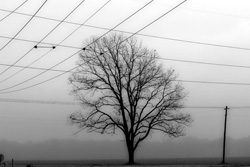
The picture above is a bit more stylized, or if you want to be technical “way over-exposed.” I only offer it as an alternative view.
Saturday, July 22, 2006
The neighbor of indifference

I was going through some of my photos from last year that I had half forgotten. It was Thanksgiving week and I was visiting family. In most ways, it is a very bad place, but on the positive side I can work on two of my ongoing photo projects while I’m there -- power plants and ancient Indian sites. There are hardly any patches of land back there where a power plant is not visible in the distance and major pre-columbian sites are all over the place. I’ve seen artifacts from within miles of my family’s properties in museums from Seattle to Brooklyn. The Smithsonian Indian museum currently has a two pots from there on display. Of course very few people back there other than relic hunters (that’s the polite term for grave robbers) know anything about it. Nothing is taught in the schools and there are no historical markers.
From a few spots I can frame Indian mounds in the foreground and a power plant in the background. But that kind of shot, unfortunately, is only interesting to me, and then only intellectually. Aesthetically I have yet to capture what I know about the scene with the camera. That’s not always the case at the ancient sites. Sometimes there is a palpable aura that remains manifest in the photograph even though there’s no outward clue, but not there, at least not on that day.
Anyway, this is not about power plants or ancient Indian sites. That morning I came across several isolated patches of forest that had been severely damaged by tornados that had passed through several nights before. So I snapped a few tourist-ish pictures of the damaged trees like the one above. About ten miles from there, one tornado had touched down in the obligatory trailer park and killed over twenty people.
At dinner that night my brother-in-law wanted to show us a movie he had helped make for his church. Bill is one of those salt of the earth types. He is a man of few words, a high school graduate who works low skilled blue collar jobs. He is currently driving a fork truck. Unlike most people of his class back there, he doesn’t drink, smoke, or shoot meth, He is hardworking and trustworthy and I’ve no doubt he’ll eventually manage a warehouse or small factory. He is a volunteer fireman, the type of guy you can count on him to help a stranger fix a flat or a friend or family member move or paint the house. He is a very active member of a fundamentalist Baptist church. It’s not quite a mega-church, but is moving in that direction.
So, being a movie buff as well as a student of human nature, I was interested to see this DVD. It was a record of the devastation in the trailer park. It started with scenes taken from a circling helicopter and then focused on the twisted metal and scattered debris and the people doing their best to salvage what they could. It also included interviews with government workers, Christian groups and other volunteers who were there to help. The soundtrack was an upbeat Christian pop song with a message of hope. The point seemed to be that God was good and merciful because people were helping the survivors.
I was very surprised by the quality of the work. It was professional. Not Hollywood professional or even the late local news, but it was technically in the realm of corporate videos. It was clear that the people working the cameras and doing the editing had some training.
And they did have some training. I learned that there is a movement within the fundamentalist churches to train their members in the video arts in order to take advantage of events such as the tornado to entertain the flock and bring in new members. His church had a little studio with lighting, several cameras and a couple editing stations and offered classes to members.
I found the video to be disgusting and ultimately scary. I think a lot about photojournalistic ethics and can argue many situations either way, but this was outright exploitation. Over twenty people were killed and over a hundred homes were destroyed or severely damaged. I can see filming that from a photojournalistic perspective. I can see filming it from an artistic motivation. Hell, I can even understand people snapping tourist pictures of the devastation. But to use it for a propaganda film, and one that extols God’s mercy at that, is just sickening. The fact that these people are acquiring sophisticated tools and techniques to create more effective propaganda is very disturbing.

